

RB Omiya Ardija - Ventforet Kofu - live odds and in-play markets
What RB Omiya Ardija - Ventforet Kofu is and where it runs
A slip holds one selection just as easily as it ties several of the evening's fixtures together. This page follows RB Omiya Ardija - Ventforet Kofu from the first whistle to the last, and the board refreshes on its own while the ball is in play. The fixture belongs to Japan. J-League Division 2, so the stage of that competition applies to this game too.
Every competition belongs to a governing body and covers a defined perimeter — a city, a country, a continent — and that perimeter already says who is entitled to appear in it. The level of a competition decides how deep the in-play list runs. Money on the table sorts competitions as reliably as any honours list; a serious purse brings in entrants who would otherwise have filled that week somewhere else. A meeting of RB Omiya Ardija and Ventforet Kofu in a lower division opens fewer markets than a top-flight fixture, and the board shows only what is genuinely trading at that minute.
Head-to-head history sits beside the live board for a reason. When both camps have scored in almost every meeting, the both-teams-to-score market feeds straight off that record. Earlier meetings of RB Omiya Ardija and Ventforet Kofu describe habits rather than outcomes, while the standings and the rest of the calendar stay on Japan. J-League Division 2 for anyone checking what this result changes.
Reading the board while the game runs


Under the scoreline sit the minute, the pressure counters and the price column. When one outcome shortens, the others lengthen in the same breath: prices on a single meeting form one set, and the shift is shared between them. A goal, a dismissal or a penalty award rewrites that column at once, so the number seen a second earlier is not the number the coupon accepts.
The closing stage belongs to whoever kept something in reserve; fresh legs introduced late run against worn bodies, and that difference decides more endings than any statistic. Reading a football match means watching where the ball spends its minutes, not only what the scoreline says. Late-game cramps are visible before they cost anything, and a player down stretching his calf announces coming space in his zone, often before the odds have reacted. Such turns arrive without warning, and the market answers before the crowd does.
After a long interruption — weather, floodlights — the reopening happens in stages: the main outcomes return first, and the side markets light up again afterwards. At the interval the list shrinks to the markets that survive a break and reopens when play restarts; a long stoppage for treatment or a video review does the same.
Live markets on this fixture
The real depth of any fixture shows up in its markets. The in-play list for football is built in layers: the result, then goals, then the small events that repeat dozens of times in a game. The winner line anchors everything else in the set, with the remaining base positions priced around the favourite it names. Those base lines stay open almost from kick-off to the final whistle.
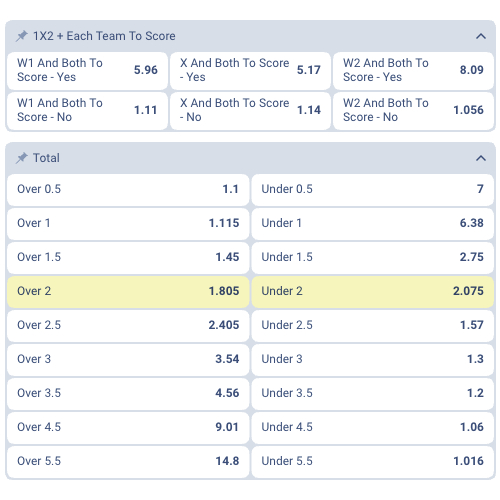
Minute-level markets exist only where a reliable feed comes up from the venue; without that collection the sheet stays on its basic lines, whatever the fixture's prestige. Depth follows coverage, so a widely tracked fixture opens corner and card lines that a quieter one never shows. Some markets only come to life after kick-off — next goal, the outcome of the remaining time, or the first team to reach a set number of corners. Live play adds lines that the pre-match board simply does not carry. The table below shows what each family settles on.
Market | What the bet covers | How it behaves in play |
|---|---|---|
1X2 live | A win for RB Omiya Ardija, a draw, or a win for Ventforet Kofu from the current score | Reprices after every goal and every red card |
Total goals | Goals from both sides together, over or under the posted line | The line drops as the minutes run out |
Asian handicap | One side starts the coupon with a goal advantage | Moves as soon as the game turns one-sided |
Both teams to score | Whether RB Omiya Ardija and Ventforet Kofu both find the net | Closes once the answer can no longer change |
Next goal | Which side scores next, or nobody does | Settles at the next goal or at the whistle |
Corners and cards | The count of corners or cards in a half or across the game | Runs while play continues, pauses at the break |
Correct score | The exact scoreline at the end of the match | Swings hardest in the seconds after a goal |
A market you cannot explain to someone else in one plain sentence is not a market you control well enough to put a single dirham behind it. A market taken because it matches what is happening on the pitch lasts longer than one taken out of habit, and the lines above are read against the clock.
What moves the price right now
A key man pulls up, limps off, and the balance of the entire match tilts with him; that one change is often enough on its own to move both the handicap and the final-result odds. Each of those turns reaches the coupon within seconds. A goal scored on the stroke of half-time follows both teams into the dressing room, where the plan for the second half gets rewritten during the break. One goal shifts the totals line, the handicap and the result price in the same refresh.
A foul inside the area punished with both a penalty and a red turns a match on a single action: a goal all but given, and a man missing until the final whistle. A red card leaves a side a player short for the rest of the game, and the market treats the remaining minutes as a different match. A team travelling for a point builds its first half around safety and opens up only after the interval, and only while the scoreboard is still kind to it. The two halves seldom carry the same rhythm, and the second is where the goal lines usually get decided.
The target zone shapes the whole set piece: a driven ball to the near post hunts a flick-on, while a floated trajectory to the far post looks for the tallest man's leap. Corners and free kicks near the area are the shortest route to a goal when a side cannot build through the middle. An extra centre-back brought on to protect a slender lead shuts the match down: space disappears, play drifts away from both boxes, and chances dry up until the whistle. Fresh legs after the hour change the pressing distance, and the goal markets answer within a few minutes.
Match statistics: what they show and what they hide
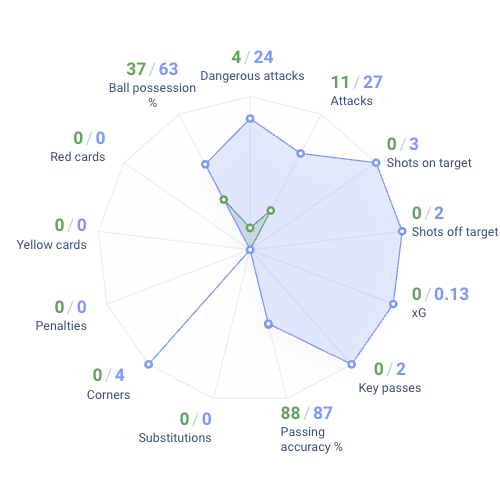
Over a short spell live numbers are mostly noise, and different data feeds do not log the same action at the same moment, so let the match breathe before concluding. Possession, shots, shots on target, corners and dangerous attacks describe pressure, and pressure is what the goal markets price. Possession share says nothing about direction of play; some teams hold the ball without going anywhere, others hand it over on purpose to strike on the counter. A side can hold the ball for an hour without troubling the keeper, and the counter still reads in its favour.
The height of the defensive block depends directly on the goalkeeper: one who sweeps far from his line lets the defenders push up, while one who stays home forces the whole team to sit deeper. One goalkeeper in form wipes out the gap the shot count promised. A long interruption resets everything; after weeks without competition, the momentum carried into the pause has lost most of its predictive value. Recent form of RB Omiya Ardija and Ventforet Kofu explains the opening prices, then loses weight with every minute the fixture actually plays.
Placing a bet while the game is live
The search field reaches a fixture faster than the sport tree. The route is identical on a computer and on a phone.
Ordering the list by start time pushes the nearest meetings to the top, while everything scheduled for later slides down and stops crowding the screen. The football list in live football holds the fixture in place from kick-off to the final whistle.
Tap the price of the market you want. Nothing is committed until you validate, so the slip stays open while you keep browsing and takes in picks from other competitions along the way. The coupon stores that figure as it stood at the tap.
Enter the stake in dirhams and check the return the coupon calculates.
Prices can move while the slip sits open; depending on the setting chosen, validation goes through at the new figure or stops to ask again, and that preference is picked beforehand, not afterwards. A price that moved while you were typing comes back for acceptance instead of being swapped in silently.
Follow the ticket in the list of open bets, where settlement appears once the result is official.
Where the option is offered, a running bet can be closed early for the sum shown at that moment, a judgement about the minutes still to come rather than the final score.
Prematch and live on the same fixture
After a losing live bet, the urge to win it back inside the same meeting arrives at once, whereas pre-match the next opportunity is hours away and the wait does the cooling by itself. The prematch line opens days ahead on the football line and closes the moment the referee starts play. Forming your own estimate before opening the odds page reverses the usual order, and the gap between your figure and the posted price becomes the information that matters. A price taken early carries the risk of team news; one taken in play carries the risk of the next attack.
A total set before the start drops a line as soon as the scoring begins, because live totals are priced on the time that remains. A position opened before kick-off and an addition made twenty minutes in can sit in the same ticket list. Bet on football as it unfolds, with in-play odds shifting after every goal, red card or clear chance. The board stays open to the last action, and the rest of the live section works on the same clock for every other sport in play.
Money, app and help in Morocco
A glance at the balance line after confirming shows the money has landed, and the betslip is then built on a figure that is certain. An account held in Morocco is funded and settled in dirhams, so no conversion stands between the deposit and the stake. Sums go out in dirhams exactly as they stood on the balance, with no intermediate conversion and no gap between what was requested and what eventually lands. A withdrawal is requested from the same cashier screen, which lists the methods open for it at that moment.
Method | What it is | Currency | Suits a bettor who |
|---|---|---|---|
CIH | Moroccan bank, cards and transfers | MAD | already banks there and pays from the banking app |
Attijari | Moroccan banking network with branches nationwide | MAD | holds a card from the same group |
Al Barid | Postal banking service | MAD | uses the post office network every day |
Lbankalik | Everyday Moroccan banking service | MAD | handles the account mostly from a phone |
Cash Plus | Cash payment network with staffed counters | MAD | pays in notes at a counter, without a card |
Alerts can be filtered down to the competitions you actually follow and switched off everywhere else, something a browser tab has no way of offering. A phone left on the fixture screen shows the same prices as a computer, and the mobile app page sets out what the download asks for. One quick download brings the whole platform to your screen. A goal alert lands faster than a manual refresh, which decides whether a market is still open when you reach it.
One question per ticket works better, since mixing several topics sends the case off to different teams and pushes the answer further away. A stake that did not go through is easiest to raise from inside the account, where the ticket carries its own number. When a fixture is interrupted or postponed, the adviser explains what happens to the stake and how the accumulator is recalculated without that selection. The reply arrives in the same window, and the thread keeps the history.
After the final whistle
The mobile app carries the same notifications away from the desk, so the signal reaches your pocket when the competition resumes, with no screen left to watch. Settlement runs against the official result, and the ticket moves from the open list into the history. Prices alone map the hierarchy of a fixture: the favourite carries the lowest figure, and the gap to the other column says how open the outcome is judged to be. The competition carries on, and the next round for RB Omiya Ardija and Ventforet Kofu appears on the same list within hours.
Kickoff is just moments away. A game still in play keeps its board alive to the last kick, and the list rolls on to the next kick-off as soon as this one closes.