

Shakhtar Donetsk U19 - Fenerbahce U19 - live odds and in-play markets
What Shakhtar Donetsk U19 - Fenerbahce U19 is and where it runs
The closer the day of the event, the sharper the impatience, fed by the promise of a memorable contest. This page follows Shakhtar Donetsk U19 - Fenerbahce U19 from the first whistle to the last, and the board refreshes on its own while the ball is in play. The fixture belongs to UEFA Youth League, so the stage of that competition applies to this game too.
Results here outlive the day they were produced; each one enters a standing table, weighs on everything that follows, and cannot be shrugged off the way a friendly can. The level of a competition decides how deep the in-play list runs. The list of winners over a decade settles the question: two names coming back over and over point to a narrow field, ten different champions point to genuine competition. A meeting of Shakhtar Donetsk U19 and Fenerbahce U19 in a lower division opens fewer markets than a top-flight fixture, and the board shows only what is genuinely trading at that minute.
Head-to-head history sits beside the live board for a reason. The scoring levels from their recent duels point toward the totals market far more than toward the winner market. Earlier meetings of Shakhtar Donetsk U19 and Fenerbahce U19 describe habits rather than outcomes, while the standings and the rest of the calendar stay on UEFA Youth League for anyone checking what this result changes.
Reading the board while the game runs
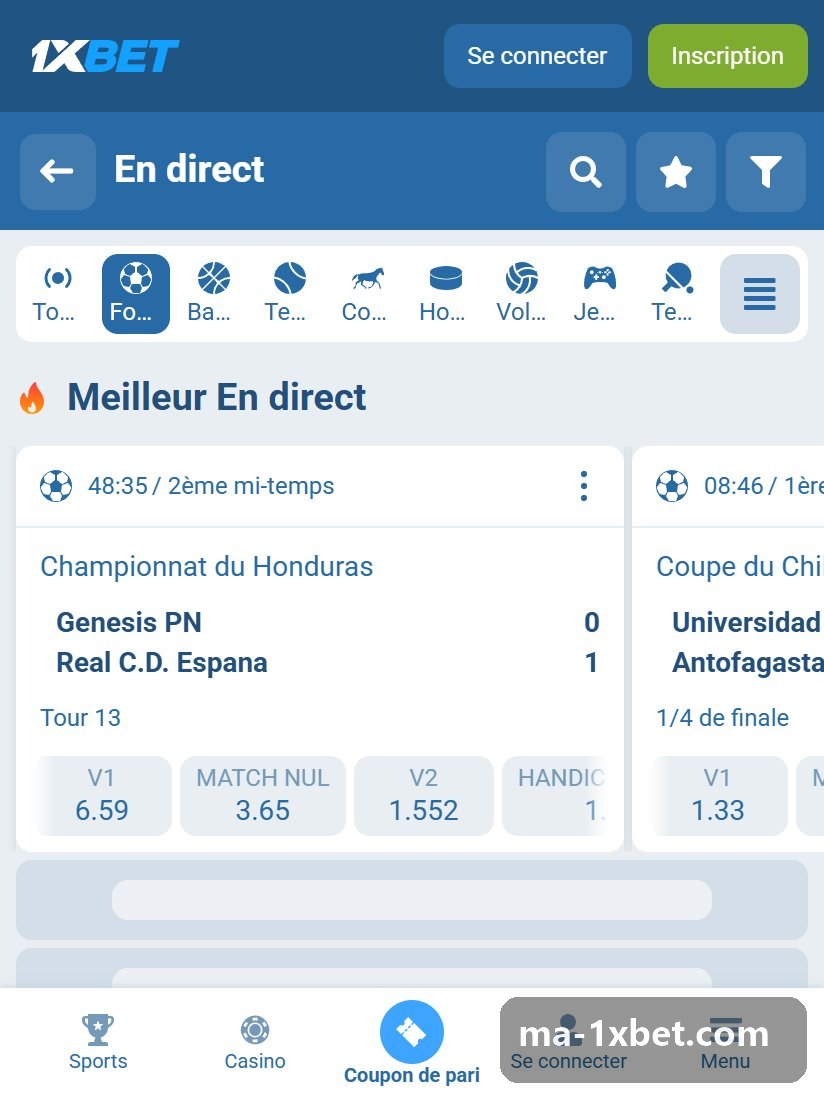

Under the scoreline sit the minute, the pressure counters and the price column. The break between periods carries the sharpest single correction of the evening, since the reassessment is made with the whole first stretch in view. A goal, a dismissal or a penalty award rewrites that column at once, so the number seen a second earlier is not the number the coupon accepts.
Watch who sets the tempo. The side that decides when the meeting speeds up and when it slows holds an edge that rarely reaches the figures column. Reading a football match means watching where the ball spends its minutes, not only what the scoreline says. A switch to a back five without any substitution shows in the wing-backs' positioning, as the team admits it is playing the scoreline, and the goal lines drift downward. Such turns arrive without warning, and the market answers before the crowd does.
One closed market points to something happening in the game; the whole meeting vanishing from the screen usually signals a data interruption, and it returns once the feed is restored. At the interval the list shrinks to the markets that survive a break and reopens when play restarts; a long stoppage for treatment or a video review does the same.
Live markets on this fixture
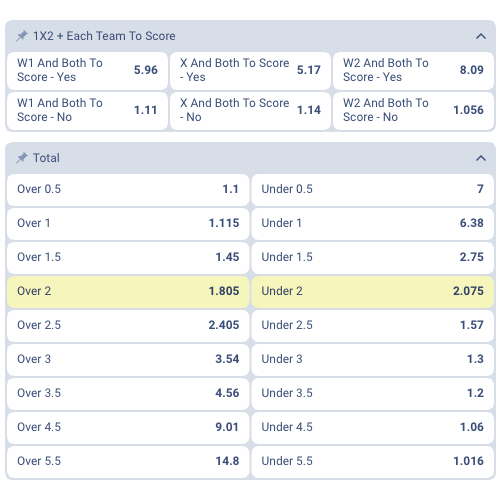
In running play the totals line is recalculated on what remains to be played. The in-play list for football is built in layers: the result, then goals, then the small events that repeat dozens of times in a game. Each base position answers a different question: who finishes ahead, by what margin, and how open the meeting stays until the end. Those base lines stay open almost from kick-off to the final whistle.
Every extra line is also a building block for a combined bet: a well-stocked sheet multiplies the assemblies possible across one round, provided each leg of the build is understood on its own. Depth follows coverage, so a widely tracked fixture opens corner and card lines that a quieter one never shows. The meeting also splits into segments: a half, a period, a set or a round depending on the sport, with lines on the result or total of a given segment. These reward knowing a side's tempo, slow starters and strong finishers alike. The table below shows what each family settles on.
Market | What the bet covers | How it behaves in play |
|---|---|---|
1X2 live | A win for Shakhtar Donetsk U19, a draw, or a win for Fenerbahce U19 from the current score | Reprices after every goal and every red card |
Total goals | Goals from both sides together, over or under the posted line | The line drops as the minutes run out |
Asian handicap | One side starts the coupon with a goal advantage | Moves as soon as the game turns one-sided |
Both teams to score | Whether Shakhtar Donetsk U19 and Fenerbahce U19 both find the net | Closes once the answer can no longer change |
Next goal | Which side scores next, or nobody does | Settles at the next goal or at the whistle |
Corners and cards | The count of corners or cards in a half or across the game | Runs while play continues, pauses at the break |
Correct score | The exact scoreline at the end of the match | Swings hardest in the seconds after a goal |
Before confirming, check how the line settles and which part of the meeting it covers, since the same correct reading can win under one set of terms and lose under another. A market taken because it matches what is happening on the pitch lasts longer than one taken out of habit, and the lines above are read against the clock.
What moves the price right now
Goals don't always come off a striker's boot — a deflection, a mix-up at the back, an own goal, and the scoreboard moves when you least expect it, keeping the both-teams-to-score market alive right to the final minutes. Each of those turns reaches the coupon within seconds. The opening goal settles half of the both-teams-to-score question, and the rest hangs on whether the side behind still keeps a genuine attacking route forward. One goal shifts the totals line, the handicap and the result price in the same refresh.
Every card freezes play for a moment, protest, a wall to set, tempers to cool, so matches broken up by sanctions spill into long added time, the familiar window for late goals. A red card leaves a side a player short for the rest of the game, and the market treats the remaining minutes as a different match. Added time carries more weight after the break, with stoppages piling up and changes running one after another, so a match is still alive when it already looks over. The two halves seldom carry the same rhythm, and the second is where the goal lines usually get decided.
A corner commits both teams at once; the side sending its tall players forward leaves its own half thinned out, and one caught clearance launches runners into open space. Corners and free kicks near the area are the shortest route to a goal when a side cannot build through the middle. Ahead of a congested week, the team sheet released an hour before kick-off can show half a different side, and the price set days earlier no longer matches what walks out. Fresh legs after the hour change the pressing distance, and the goal markets answer within a few minutes.
Match statistics: what they show and what they hide
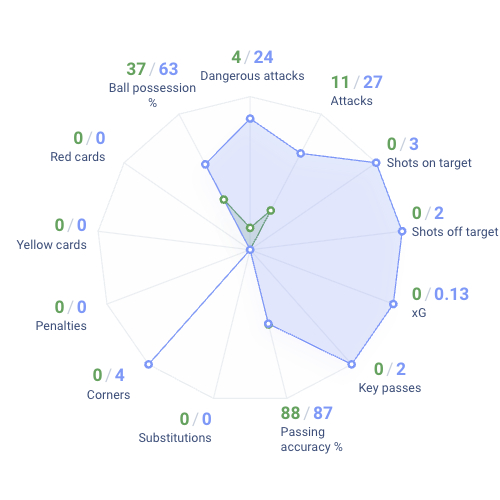
Points and performance drift apart: a side creating plenty and finishing badly tends to convert eventually, and its position catches up with its chances more often than the other way round. Possession, shots, shots on target, corners and dangerous attacks describe pressure, and pressure is what the goal markets price. Mid-season standings mislead whenever teams have played unequal numbers of games; a fixture in hand can be worth several places, and no line of the table shows it. A side can hold the ball for an hour without troubling the keeper, and the counter still reads in its favour.
A reserve keeper often arrives after months without a competitive minute. Match rhythm cannot be rehearsed in training, and his first hot intervention is also his first real action in a long while. One goalkeeper in form wipes out the gap the shot count promised. A run resting on one decisive figure stays fragile by design, since a single absence can undo in one round what took weeks to build. Recent form of Shakhtar Donetsk U19 and Fenerbahce U19 explains the opening prices, then loses weight with every minute the fixture actually plays.
Placing a bet while the game is live
The steps to place a bet stay the same every time. The route is identical on a computer and on a phone.
The counter shown next to each competition tells how many meetings are currently open, answering before any click whether the page is worth opening. The football list in live football holds the fixture in place from kick-off to the final whistle.
Tap the price of the market you want. With a system you decide how many picks must land together inside each combination, and the longer your starting list, the more combinations the slip builds from it. The coupon stores that figure as it stood at the tap.
Enter the stake in dirhams and check the return the coupon calculates.
One press is enough: on a slow connection the urge to tap again can send two identical slips, and the second one settles exactly like the first. A price that moved while you were typing comes back for acceptance instead of being swapped in silently.
Follow the ticket in the list of open bets, where settlement appears once the result is official.
Where the option is offered, a running bet can be closed early for the sum shown at that moment, a judgement about the minutes still to come rather than the final score.
Prematch and live on the same fixture
One stake placed before the start is a single amount weighed once, in dirhams; live, decisions arrive one after another and the total committed gets harder to track. The prematch line opens days ahead on the football line and closes the moment the referee starts play. Earlier encounters between the two opponents can be reread without hurry before the start, and some pairings keep the same face from one edition to the next. A price taken early carries the risk of team news; one taken in play carries the risk of the next attack.
Live betting earns its place when the play contradicts expectations, since an injury, a sudden turn or a change of plan reopens the contest. A position opened before kick-off and an addition made twenty minutes in can sit in the same ticket list. The broadcast picture arrives on a slight delay, so the odds react to the data before your screen shows the action — a lag that explains many seemingly mysterious moves. The board stays open to the last action, and the rest of the live section works on the same clock for every other sport in play.
Money, app and help in Morocco
The holder of the payment instrument and the holder of the account have to be the same person, and even a small spelling gap in the name is enough to hold the credit up. An account held in Morocco is funded and settled in dirhams, so no conversion stands between the deposit and the stake. The moment a request is sent, the amount leaves the available balance and can no longer feed a betting slip while the operation is being decided. A withdrawal is requested from the same cashier screen, which lists the methods open for it at that moment.
Method | What it is | Currency | Suits a bettor who |
|---|---|---|---|
CIH | Moroccan bank, cards and transfers | MAD | already banks there and pays from the banking app |
Attijari | Moroccan banking network with branches nationwide | MAD | holds a card from the same group |
Al Barid | Postal banking service | MAD | uses the post office network every day |
Lbankalik | Everyday Moroccan banking service | MAD | handles the account mostly from a phone |
Cash Plus | Cash payment network with staffed counters | MAD | pays in notes at a counter, without a card |
When a bet settles, a dedicated alert reports it, and the fate of the slip is known without reopening the history or reloading the account page. A phone left on the fixture screen shows the same prices as a computer, and the mobile app page sets out what the download asks for. A single download puts the entire platform on your screen. A goal alert lands faster than a manual refresh, which decides whether a market is still open when you reach it.
A screenshot of the problem carries more than a long paragraph, since the agent sees exactly what you saw instead of rebuilding the scene from words. A stake that did not go through is easiest to raise from inside the account, where the ticket carries its own number. On a niche market the maximum stake stays lower than on the main market of a headline fixture, and the service states the limit set for that event. The reply arrives in the same window, and the thread keeps the history.
After the final whistle
When a fixture is moved, the new date takes the old one's place in the programme itself; the calendar shown tracks the changes rather than keeping a stale time. Settlement runs against the official result, and the ticket moves from the open list into the history. Prices alone map the hierarchy of a fixture: the favourite carries the lowest figure, and the gap to the other column says how open the outcome is judged to be. The competition carries on, and the next round for Shakhtar Donetsk U19 and Fenerbahce U19 appears on the same list within hours.
Bets on running events are placed from the live section. A game still in play keeps its board alive to the last kick, and the list rolls on to the next kick-off as soon as this one closes.