

San Jose Earthquakes - Portland Timbers - live odds and in-play markets
What San Jose Earthquakes - Portland Timbers is and where it runs
An opening price rarely survives untouched, tightening or drifting as news and money come in. This page follows San Jose Earthquakes - Portland Timbers from the first whistle to the last, and the board refreshes on its own while the ball is in play. The fixture belongs to USA. MLS, so the stage of that competition applies to this game too.
The format writes the route: in a league everyone meets everyone and the sum decides, while in straight elimination one defeat closes the road. The level of a competition decides how deep the in-play list runs. The list of winners over a decade settles the question: two names coming back over and over point to a narrow field, ten different champions point to genuine competition. A meeting of San Jose Earthquakes and Portland Timbers in a lower division opens fewer markets than a top-flight fixture, and the board shows only what is genuinely trading at that minute.
Head-to-head history sits beside the live board for a reason. Home and away meetings between these sides rarely end with the same scorelines, so the archive is worth reading venue by venue. Earlier meetings of San Jose Earthquakes and Portland Timbers describe habits rather than outcomes, while the standings and the rest of the calendar stay on USA. MLS for anyone checking what this result changes.
Reading the board while the game runs


Under the scoreline sit the minute, the pressure counters and the price column. During a decisive phase the market pauses for a few seconds and comes back at another price, once the situation has been settled in play. A goal, a dismissal or a penalty award rewrites that column at once, so the number seen a second earlier is not the number the coupon accepts.
The closing stage belongs to whoever kept something in reserve; fresh legs introduced late run against worn bodies, and that difference decides more endings than any statistic. Reading a football match means watching where the ball spends its minutes, not only what the scoreline says. A switch to a back five without any substitution shows in the wing-backs' positioning, as the team admits it is playing the scoreline, and the goal lines drift downward. Such turns arrive without warning, and the market answers before the crowd does.
Every pause carries information of its own: it flags that something on the field matters, sometimes before the viewer at home has worked out what. At the interval the list shrinks to the markets that survive a break and reopens when play restarts; a long stoppage for treatment or a video review does the same.
Live markets on this fixture
The real depth of any fixture shows up in its markets. The in-play list for football is built in layers: the result, then goals, then the small events that repeat dozens of times in a game. Most tickets on the tournament land on these few positions, which keeps them under constant correction and leaves little room for a mispriced line to survive very long. Those base lines stay open almost from kick-off to the final whistle.
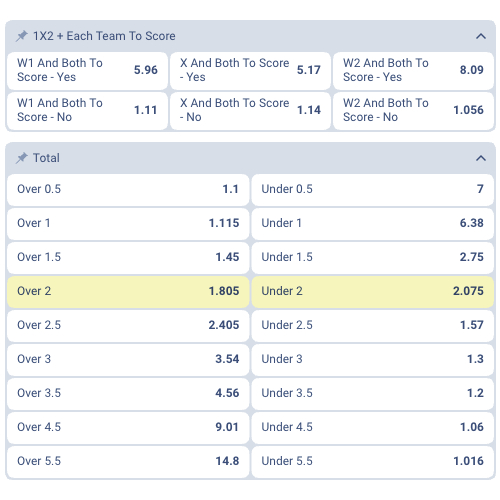
In play the sheet swells again at every pause: half-time or the gap between two sets reopens lines on the coming segment before the next tightening. Depth follows coverage, so a widely tracked fixture opens corner and card lines that a quieter one never shows. Popular choices range from the outright winner and double chance to handicaps, total goals, both teams to score and the exact final score. Half-time/full-time and a spread of player and team props complete the list, and any number of them can be tied into an accumulator. The table below shows what each family settles on.
Market | What the bet covers | How it behaves in play |
|---|---|---|
1X2 live | A win for San Jose Earthquakes, a draw, or a win for Portland Timbers from the current score | Reprices after every goal and every red card |
Total goals | Goals from both sides together, over or under the posted line | The line drops as the minutes run out |
Asian handicap | One side starts the coupon with a goal advantage | Moves as soon as the game turns one-sided |
Both teams to score | Whether San Jose Earthquakes and Portland Timbers both find the net | Closes once the answer can no longer change |
Next goal | Which side scores next, or nobody does | Settles at the next goal or at the whistle |
Corners and cards | The count of corners or cards in a half or across the game | Runs while play continues, pauses at the break |
Correct score | The exact scoreline at the end of the match | Swings hardest in the seconds after a goal |
Available time belongs in the equation, and with no way to watch the meeting, a position that needs no in-play management is the better fit. A market taken because it matches what is happening on the pitch lasts longer than one taken out of habit, and the lines above are read against the clock.
What moves the price right now
The ball hits the net, the arms go up, then the referee reaches for his ear: while the video check runs the markets freeze, and a goal chalked off sends the odds straight back where they came from. Each of those turns reaches the coupon within seconds. A goal scored on the stroke of half-time follows both teams into the dressing room, where the plan for the second half gets rewritten during the break. One goal shifts the totals line, the handicap and the result price in the same refresh.
A card aimed at the bench does not automatically enter the tally; the market rules state which bookings count, and reading them spares a surprise at settlement. A red card leaves a side a player short for the rest of the game, and the market treats the remaining minutes as a different match. Winning both halves, or scoring in each of them, stands as a market of its own and asks a lot even of a big favourite, since dominating before and after the break without a lull is rare. The two halves seldom carry the same rhythm, and the second is where the goal lines usually get decided.
On the last corner of a match slipping away, the goalkeeper walks up into the opposite box, and the danger runs both ways because the net behind him stands empty. Corners and free kicks near the area are the shortest route to a goal when a side cannot build through the middle. An injury forces an unplanned change and burns one of the options: the plan for the closing stage collapses, and the coach finishes with the players he has, not the ones he wanted. Fresh legs after the hour change the pressing distance, and the goal markets answer within a few minutes.
Match statistics: what they show and what they hide
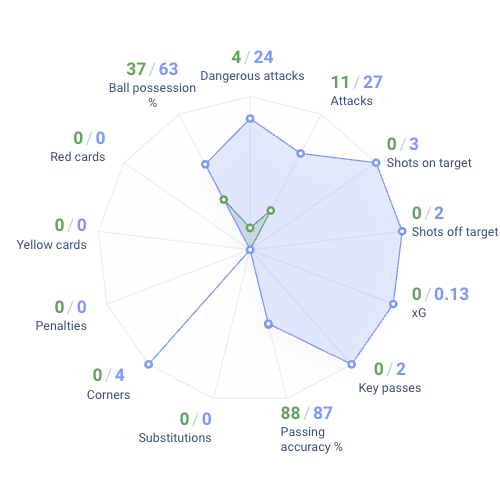
Over a short spell live numbers are mostly noise, and different data feeds do not log the same action at the same moment, so let the match breathe before concluding. Possession, shots, shots on target, corners and dangerous attacks describe pressure, and pressure is what the goal markets price. A run of matches without conceding can come from a solid defence or from opponents who finished badly. Both situations leave exactly the same clean line on the team sheet. A side can hold the ball for an hour without troubling the keeper, and the counter still reads in its favour.
News about the goalkeeper tends to arrive last: a problem felt during the warm-up is enough to change the team sheet after the published lineups have gone round, leaving nobody time to react. One goalkeeper in form wipes out the gap the shot count promised. A run is worth only as much as the opponents inside it; stacking wins against the bottom of the table prepares nobody for the first genuine test of the competition. Recent form of San Jose Earthquakes and Portland Timbers explains the opening prices, then loses weight with every minute the fixture actually plays.
Placing a bet while the game is live
System mode spreads the same picks across several combinations. The route is identical on a computer and on a phone.
When the same pair turns up twice in the calendar, the date and time printed beside the names are the only reliable way to tell one meeting from the other. The football list in live football holds the fixture in place from kick-off to the final whistle.
Tap the price of the market you want. As soon as a stake is typed in, the slip displays the potential return, so what each choice would pay is visible before anything is confirmed. The coupon stores that figure as it stood at the tap.
Enter the stake in dirhams and check the return the coupon calculates.
A meeting that gets under way while you are still filling the slip takes its pre-match line with it, so the pick has to be made again from the live section. A price that moved while you were typing comes back for acceptance instead of being swapped in silently.
Follow the ticket in the list of open bets, where settlement appears once the result is official.
Where the option is offered, a running bet can be closed early for the sum shown at that moment, a judgement about the minutes still to come rather than the final score.
Prematch and live on the same fixture
Everything is open days ahead, side markets included, then the choice narrows during the meeting to whatever is still undecided, and it keeps shrinking as things settle. The prematch line opens days ahead on the football line and closes the moment the referee starts play. Waiting for confirmed news about the participants changes what a fixture is worth, since one late absence shifts the balance between them and gives real cause to rethink. A price taken early carries the risk of team news; one taken in play carries the risk of the next attack.
Live markets freeze for a moment when something decisive happens and reopen with prices already rewritten. A position opened before kick-off and an addition made twenty minutes in can sit in the same ticket list. On nights when fixtures run in parallel, live picks from different grounds can be gathered into one accumulator, and the whole evening turns into a single ticket to follow. The board stays open to the last action, and the rest of the live section works on the same clock for every other sport in play.
Money, app and help in Morocco
Lbankalik lives entirely on the phone, so moving from the banking screen to a deposit happens without ever changing device. An account held in Morocco is funded and settled in dirhams, so no conversion stands between the deposit and the stake. Every request passes a check of the account details before execution, and that step is what sits between hitting send and seeing the money move. A withdrawal is requested from the same cashier screen, which lists the methods open for it at that moment.
Method | What it is | Currency | Suits a bettor who |
|---|---|---|---|
CIH | Moroccan bank, cards and transfers | MAD | already banks there and pays from the banking app |
Attijari | Moroccan banking network with branches nationwide | MAD | holds a card from the same group |
Al Barid | Postal banking service | MAD | uses the post office network every day |
Lbankalik | Everyday Moroccan banking service | MAD | handles the account mostly from a phone |
Cash Plus | Cash payment network with staffed counters | MAD | pays in notes at a counter, without a card |
When a bet settles, a dedicated alert reports it, and the fate of the slip is known without reopening the history or reloading the account page. A phone left on the fixture screen shows the same prices as a computer, and the mobile app page sets out what the download asks for. Install the mobile app and keep every match within reach. A goal alert lands faster than a manual refresh, which decides whether a market is still open when you reach it.
Evenings with a big fixture on concentrate the requests, and a question that can be asked in the morning comes back noticeably faster. A stake that did not go through is easiest to raise from inside the account, where the ticket carries its own number. The 1xBet support team stays online around the clock, so there is always someone ready to help the moment a question comes up. The reply arrives in the same window, and the thread keeps the history.
After the final whistle
When a fixture is moved, the new date takes the old one's place in the programme itself; the calendar shown tracks the changes rather than keeping a stale time. Settlement runs against the official result, and the ticket moves from the open list into the history. Between rounds the list shrinks to a handful of rows; as a busy phase approaches it stretches across several screens. The competition carries on, and the next round for San Jose Earthquakes and Portland Timbers appears on the same list within hours.
Kickoff is almost here. A game still in play keeps its board alive to the last kick, and the list rolls on to the next kick-off as soon as this one closes.