

Motor Trachenberge II - Cossebaude II - live odds and in-play markets
What Motor Trachenberge II - Cossebaude II is and where it runs
Anticipation runs high whenever two strong sides are set to meet, and the countdown to the first whistle is half the thrill. This page follows Motor Trachenberge II - Cossebaude II from the first whistle to the last, and the board refreshes on its own while the ball is in play. The fixture belongs to Germany. Feldschloesschen Cup, so the stage of that competition applies to this game too.
Pulling out midway is not a free decision — a withdrawal brings sanctions with it and distorts the run of everyone else still involved. The level of a competition decides how deep the in-play list runs. The venue chosen for the decisive stage teaches as much as the rulebook: a final scheduled in the largest available stadium does not carry the standing of one played at the better-placed team's ground. A meeting of Motor Trachenberge II and Cossebaude II in a lower division opens fewer markets than a top-flight fixture, and the board shows only what is genuinely trading at that minute.
Head-to-head history sits beside the live board for a reason. Curious who usually comes out on top when these opponents meet? The head-to-head numbers are there to check before you commit. Earlier meetings of Motor Trachenberge II and Cossebaude II describe habits rather than outcomes, while the standings and the rest of the calendar stay on Germany. Feldschloesschen Cup for anyone checking what this result changes.
Reading the board while the game runs


Under the scoreline sit the minute, the pressure counters and the price column. During a decisive phase the market pauses for a few seconds and comes back at another price, once the situation has been settled in play. A goal, a dismissal or a penalty award rewrites that column at once, so the number seen a second earlier is not the number the coupon accepts.
In front of a home crowd, noise and support inflate the impression of superiority, and the gap felt from the stands is almost always wider than the gap on the field. Reading a football match means watching where the ball spends its minutes, not only what the scoreline says. A trailing side pushing its defenders forward leaves space behind, so the next-goal market tightens in its favour while quietly getting more generous for the team countering. Such turns arrive without warning, and the market answers before the crowd does.
How long the freeze lasts depends on what is being checked: a quick look reopens within seconds, while a heavier review keeps everything closed considerably longer. At the interval the list shrinks to the markets that survive a break and reopens when play restarts; a long stoppage for treatment or a video review does the same.
Live markets on this fixture
Double chance covers two of the three outcomes and charges for that cover in the price. The in-play list for football is built in layers: the result, then goals, then the small events that repeat dozens of times in a game. Even a fixture with nothing at stake, between participants nobody follows, keeps its base intact; reputation acts on the side options and never on the base set that is always there. Those base lines stay open almost from kick-off to the final whistle.
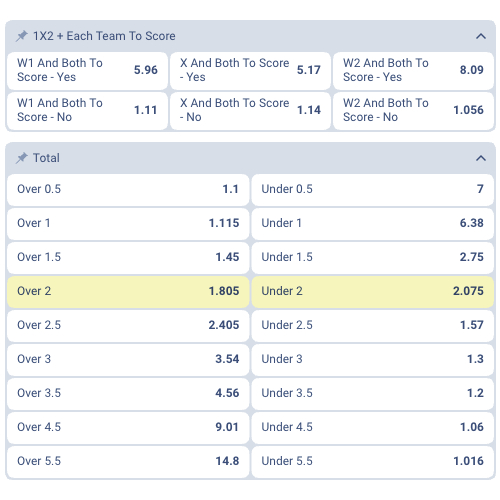
How much information exists on the participants weighs just as much: well-documented recent results and a known state of form let the sheet be sliced far more finely. Depth follows coverage, so a widely tracked fixture opens corner and card lines that a quieter one never shows. Bettors can choose the straightforward 1X2 result, play it safer with double chance, or add value through handicaps and over/under totals. Both teams to score, correct score and player or team specials are on offer too, and multiple selections slot neatly into one accumulator. The table below shows what each family settles on.
Market | What the bet covers | How it behaves in play |
|---|---|---|
1X2 live | A win for Motor Trachenberge II, a draw, or a win for Cossebaude II from the current score | Reprices after every goal and every red card |
Total goals | Goals from both sides together, over or under the posted line | The line drops as the minutes run out |
Asian handicap | One side starts the coupon with a goal advantage | Moves as soon as the game turns one-sided |
Both teams to score | Whether Motor Trachenberge II and Cossebaude II both find the net | Closes once the answer can no longer change |
Next goal | Which side scores next, or nobody does | Settles at the next goal or at the whistle |
Corners and cards | The count of corners or cards in a half or across the game | Runs while play continues, pauses at the break |
Correct score | The exact scoreline at the end of the match | Swings hardest in the seconds after a goal |
Following the same tournament across several rounds shows which markets fit its habits, and that memory serves better than starting from scratch in front of every new fixture. A market taken because it matches what is happening on the pitch lasts longer than one taken out of habit, and the lines above are read against the clock.
What moves the price right now
Goalless at the break, and the second half turns into a contest of its own: attacking substitutions, higher lines, and a second-half totals market that bears no relation to the prematch one. Each of those turns reaches the coupon within seconds. The second goal changes what the match is, since a two-goal lead turns the leader into a manager of the game, and comebacks from that far back stay rare. One goal shifts the totals line, the handicap and the result price in the same refresh.
When a fixture carries weight in the standings or pits neighbours against each other, challenges fly in higher, dissent grows, and the first bookings arrive well before the interval. A red card leaves a side a player short for the rest of the game, and the market treats the remaining minutes as a different match. The second period frequently starts with a different shape from the one that finished the first, a defender fewer, a wide man more, and the balance of the game redrawn. The two halves seldom carry the same rhythm, and the second is where the goal lines usually get decided.
Knowing who owns penalty duty matters for scorer bets, since the designated taker collects goals every season without needing to create a single chance himself. Corners and free kicks near the area are the shortest route to a goal when a side cannot build through the middle. Some coaches keep faith with the same eleven and use only one or two windows, leaving a player carrying a knock out there because nothing behind him convinces. Fresh legs after the hour change the pressing distance, and the goal markets answer within a few minutes.
Match statistics: what they show and what they hide
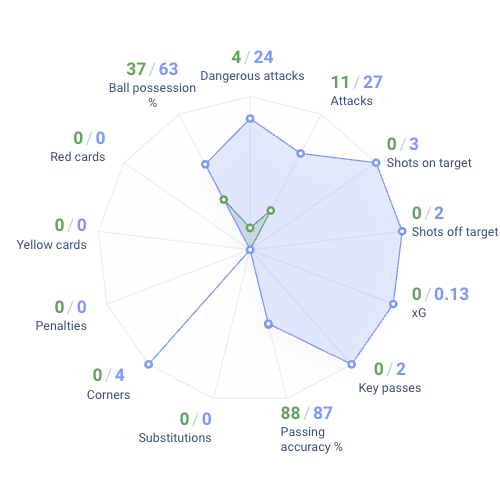
A rising corner count usually reflects crosses being blocked rather than real danger, so watch what happens after the corner before drawing any conclusion from it. Possession, shots, shots on target, corners and dangerous attacks describe pressure, and pressure is what the goal markets price. A goalkeeper leading the saves chart usually plays behind the leakiest defence, since that total counts shots faced long before it measures ability. A side can hold the ball for an hour without troubling the keeper, and the counter still reads in its favour.
Switching between a back four and a back three mid-match redistributes the flanks; for several minutes nobody is quite sure who picks up the opposite winger, and that window is where the mistakes happen. One goalkeeper in form wipes out the gap the shot count promised. Some competitors thrive against an opponent who takes the initiative and get lost against a passive profile; the style opposite often explains a run better than the quality opposite does. Recent form of Motor Trachenberge II and Cossebaude II explains the opening prices, then loses weight with every minute the fixture actually plays.
Placing a bet while the game is live
The line opens days ahead of kick-off, so a coupon can wait. The route is identical on a computer and on a phone.
Ordering the list by start time pushes the nearest meetings to the top, while everything scheduled for later slides down and stops crowding the screen. The football list in live football holds the fixture in place from kick-off to the final whistle.
Tap the price of the market you want. An open bet can be sold back before its last legs finish, at the value quoted in the history at that moment. The coupon stores that figure as it stood at the tap.
Enter the stake in dirhams and check the return the coupon calculates.
In play, confirmation runs through a short acceptance window — the bet exists once the slip comes back accepted, not the instant the finger lands on the button. A price that moved while you were typing comes back for acceptance instead of being swapped in silently.
Follow the ticket in the list of open bets, where settlement appears once the result is official.
Where the option is offered, a running bet can be closed early for the sum shown at that moment, a judgement about the minutes still to come rather than the final score.
Prematch and live on the same fixture
The mid-match break is a compromise between the two worlds: the board fills out again, prices settle, and the decision leans on a full period actually watched. The prematch line opens days ahead on the football line and closes the moment the referee starts play. Waiting for confirmed news about the participants changes what a fixture is worth, since one late absence shifts the balance between them and gives real cause to rethink. A price taken early carries the risk of team news; one taken in play carries the risk of the next attack.
An outsider's price sits at its highest before the start and shrinks the moment he moves in front. A position opened before kick-off and an addition made twenty minutes in can sit in the same ticket list. In-play football makes every attack matter, as odds rise and fall with each shot and counterattack. The board stays open to the last action, and the rest of the live section works on the same clock for every other sport in play.
Money, app and help in Morocco
A transfer from a CIH or Attijari account leaves a record on both sides at once, and that double entry makes any later check simpler. An account held in Morocco is funded and settled in dirhams, so no conversion stands between the deposit and the stake. Funds tied to a running promotion stay on the account until its conditions are cleared, so only the free part of the balance is free to leave. A withdrawal is requested from the same cashier screen, which lists the methods open for it at that moment.
Method | What it is | Currency | Suits a bettor who |
|---|---|---|---|
CIH | Moroccan bank, cards and transfers | MAD | already banks there and pays from the banking app |
Attijari | Moroccan banking network with branches nationwide | MAD | holds a card from the same group |
Al Barid | Postal banking service | MAD | uses the post office network every day |
Lbankalik | Everyday Moroccan banking service | MAD | handles the account mostly from a phone |
Cash Plus | Cash payment network with staffed counters | MAD | pays in notes at a counter, without a card |
For fixtures without pictures, the app draws an animated view of the score and key moments, enough to place the momentum before entering a live bet. A phone left on the fixture screen shows the same prices as a computer, and the mobile app page sets out what the download asks for. The mobile app puts thousands of events at your fingertips. A goal alert lands faster than a manual refresh, which decides whether a market is still open when you reach it.
Writing from inside the logged-in account removes the identity step altogether, as the agent already knows who is talking and the exchange opens on the substance. A stake that did not go through is easiest to raise from inside the account, where the ticket carries its own number. When an Al Barid or Lbankalik transfer has not reached the balance yet, the date, the amount and the reference are what the service matches it against. The reply arrives in the same window, and the thread keeps the history.
After the final whistle
Typing the competition name into the search box leads straight to its page, quicker than opening the sport menu and scrolling down to it on every visit. Settlement runs against the official result, and the ticket moves from the open list into the history. Deciding whether this competition is worth following goes quicker in the section than in any description, since the coming fixtures are already listed there with their prices. The competition carries on, and the next round for Motor Trachenberge II and Cossebaude II appears on the same list within hours.
Don't watch from the sidelines. A game still in play keeps its board alive to the last kick, and the list rolls on to the next kick-off as soon as this one closes.