

Valenciennes - Orleans - live odds and in-play markets
What Valenciennes - Orleans is and where it runs
Once play starts, the prices refresh with every goal, every point won and every swing of momentum. This page follows Valenciennes - Orleans from the first whistle to the last, and the board refreshes on its own while the ball is in play. The fixture belongs to France. Ligue 3, so the stage of that competition applies to this game too.
The length of the competition filters luck out, since a single freak result can distort one evening but rarely a table built over months of play. The level of a competition decides how deep the in-play list runs. Ask what a defeat actually costs: instant elimination, a drop to the level below, or nothing whatsoever. Where losing carries no consequence, the intensity on show follows suit. A meeting of Valenciennes and Orleans in a lower division opens fewer markets than a top-flight fixture, and the board shows only what is genuinely trading at that minute.
Head-to-head history sits beside the live board for a reason. Curious who usually comes out on top when these opponents meet? The head-to-head numbers are there to check before you commit. Earlier meetings of Valenciennes and Orleans describe habits rather than outcomes, while the standings and the rest of the calendar stay on France. Ligue 3 for anyone checking what this result changes.
Reading the board while the game runs


Under the scoreline sit the minute, the pressure counters and the price column. After a genuine turnaround the price never returns to its opening level; the market works from the present situation and drops the opinion built before the start. A goal, a dismissal or a penalty award rewrites that column at once, so the number seen a second earlier is not the number the coupon accepts.
In front of a home crowd, noise and support inflate the impression of superiority, and the gap felt from the stands is almost always wider than the gap on the field. Reading a football match means watching where the ball spends its minutes, not only what the scoreline says. The referee's first calls set the tone for the whole afternoon, since an official who lets play run invites heavier duels, and that tolerance echoes into the fouls and cards markets. Such turns arrive without warning, and the market answers before the crowd does.
Acceptance comes back carefully: right after a reopening the stake ceilings often sit lower, for as long as it takes the situation to settle and the prices to find their level. At the interval the list shrinks to the markets that survive a break and reopens when play restarts; a long stoppage for treatment or a video review does the same.
Live markets on this fixture
A handicap line evens out a lopsided fixture by spotting the underdog a head start. The in-play list for football is built in layers: the result, then goals, then the small events that repeat dozens of times in a game. A full matchday can be covered from this base alone, without opening the detailed sheet, which makes it the quickest format to scan when fixtures come one after another. Those base lines stay open almost from kick-off to the final whistle.
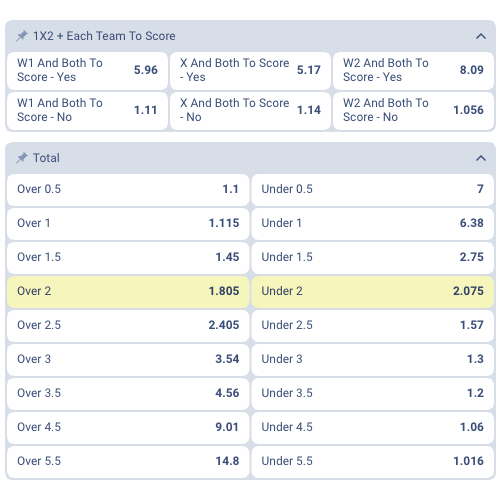
A longer list carries no extra knowledge: the side positions all derive from the same core and restate, cut differently, the same starting estimate. Depth follows coverage, so a widely tracked fixture opens corner and card lines that a quieter one never shows. Popular choices range from the outright winner and double chance to handicaps, total goals, both teams to score and the exact final score. Half-time/full-time and a spread of player and team props complete the list, and any number of them can be tied into an accumulator. The table below shows what each family settles on.
Market | What the bet covers | How it behaves in play |
|---|---|---|
1X2 live | A win for Valenciennes, a draw, or a win for Orleans from the current score | Reprices after every goal and every red card |
Total goals | Goals from both sides together, over or under the posted line | The line drops as the minutes run out |
Asian handicap | One side starts the coupon with a goal advantage | Moves as soon as the game turns one-sided |
Both teams to score | Whether Valenciennes and Orleans both find the net | Closes once the answer can no longer change |
Next goal | Which side scores next, or nobody does | Settles at the next goal or at the whistle |
Corners and cards | The count of corners or cards in a half or across the game | Runs while play continues, pauses at the break |
Correct score | The exact scoreline at the end of the match | Swings hardest in the seconds after a goal |
Wanting a particular participant to come through is not information; it shortens the analysis and pushes toward the line that feels good instead of the one that fits the facts. A market taken because it matches what is happening on the pitch lasts longer than one taken out of habit, and the lines above are read against the clock.
What moves the price right now
The ball hits the net, the arms go up, then the referee reaches for his ear: while the video check runs the markets freeze, and a goal chalked off sends the odds straight back where they came from. Each of those turns reaches the coupon within seconds. Holding a lead also eats the clock: throw-ins take an age, goal kicks stretch out, the ball spends longer outside the pitch and the goals total suffers for it. One goal shifts the totals line, the handicap and the result price in the same refresh.
A foul inside the area punished with both a penalty and a red turns a match on a single action: a goal all but given, and a man missing until the final whistle. A red card leaves a side a player short for the rest of the game, and the market treats the remaining minutes as a different match. At the interval a separate set of second-half lines opens and starts again from nil-nil, where the first act's score no longer counts and only what remains to be played is priced. The two halves seldom carry the same rhythm, and the second is where the goal lines usually get decided.
Having a genuine free-kick specialist changes the value of every foul conceded near the box; a routine block on the edge suddenly becomes a clear chance at goal. Corners and free kicks near the area are the shortest route to a goal when a side cannot build through the middle. Shape can change without anyone leaving the pitch: a full-back tucks inside, the back line becomes a three, and the game takes on a completely different look. Fresh legs after the hour change the pressing distance, and the goal markets answer within a few minutes.
Match statistics: what they show and what they hide
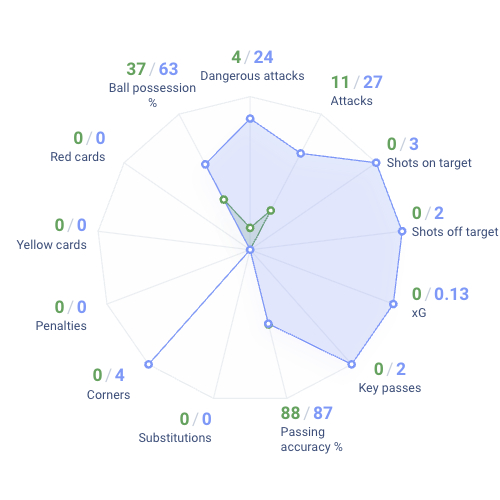
Distance covered goes up when a team is chasing the ball. A block that defends deep and shifts little often shows less running and more control. Possession, shots, shots on target, corners and dangerous attacks describe pressure, and pressure is what the goal markets price. Corner counts reward sides that cross often and sides chasing a scoreline late on, so the figure measures a style and a situation rather than dominance. A side can hold the ball for an hour without troubling the keeper, and the counter still reads in its favour.
Building the wall on a free kick is the goalkeeper's job — how many men, where they stand, which post gets covered. A keeper unfamiliar with his box leaves angles open, and a good striker of the ball spots them at once. One goalkeeper in form wipes out the gap the shot count promised. A run built entirely at home says little about what awaits on the road, where the setting and the reference points both change. Recent form of Valenciennes and Orleans explains the opening prices, then loses weight with every minute the fixture actually plays.
Placing a bet while the game is live
Setting up a wager follows the same easy path every time. The route is identical on a computer and on a phone.
Once a meeting begins it leaves the pre-match list for the live section, so a fixture that seems to have vanished from the page has usually just started. The football list in live football holds the fixture in place from kick-off to the final whistle.
Tap the price of the market you want. As soon as a stake is typed in, the slip displays the potential return, so what each choice would pay is visible before anything is confirmed. The coupon stores that figure as it stood at the tap.
Enter the stake in dirhams and check the return the coupon calculates.
Without a balance large enough to cover the stake, validation stops dead, and checking that beforehand beats discovering the block at the very moment you press. A price that moved while you were typing comes back for acceptance instead of being swapped in silently.
Follow the ticket in the list of open bets, where settlement appears once the result is official.
Where the option is offered, a running bet can be closed early for the sum shown at that moment, a judgement about the minutes still to come rather than the final score.
Prematch and live on the same fixture
Choosing your own moment stays possible while nothing has started: you come in when the price suits you. Live, the flow of the meeting sets the tempo instead. The prematch line opens days ahead on the football line and closes the moment the referee starts play. Previous meetings between the two opponents can be reread without hurry before the start, and some pairings keep the same face from one edition to the next. A price taken early carries the risk of team news; one taken in play carries the risk of the next attack.
Every match gives you two ways to play. A position opened before kick-off and an addition made twenty minutes in can sit in the same ticket list. On nights when fixtures run in parallel, live picks from different grounds can be gathered into one accumulator, and the whole evening turns into a single ticket to follow. The board stays open to the last action, and the rest of the live section works on the same clock for every other sport in play.
Money, app and help in Morocco
The holder of the payment instrument and the holder of the account have to be the same person, and even a small spelling gap in the name is enough to hold the credit up. An account held in Morocco is funded and settled in dirhams, so no conversion stands between the deposit and the stake. Money leaves along the same road it arrived on, the instrument used for funding being the one that carries it back out rather than some other channel. A withdrawal is requested from the same cashier screen, which lists the methods open for it at that moment.
Method | What it is | Currency | Suits a bettor who |
|---|---|---|---|
CIH | Moroccan bank, cards and transfers | MAD | already banks there and pays from the banking app |
Attijari | Moroccan banking network with branches nationwide | MAD | holds a card from the same group |
Al Barid | Postal banking service | MAD | uses the post office network every day |
Lbankalik | Everyday Moroccan banking service | MAD | handles the account mostly from a phone |
Cash Plus | Cash payment network with staffed counters | MAD | pays in notes at a counter, without a card |
On a weak connection the app keeps going where a browser page stalls, because it moves far less data to put the same content on the screen. A phone left on the fixture screen shows the same prices as a computer, and the mobile app page sets out what the download asks for. One quick download brings the whole platform to your screen. A goal alert lands faster than a manual refresh, which decides whether a market is still open when you reach it.
One question per ticket works better, since mixing several topics sends the case off to different teams and pushes the answer further away. A stake that did not go through is easiest to raise from inside the account, where the ticket carries its own number. Help is offered in several languages, so you can explain your issue in the words you feel most comfortable with. The reply arrives in the same window, and the thread keeps the history.
After the final whistle
The full list of a round gathers every fixture on one screen, a handy layout for building an accumulator from that same matchday without hopping between pages. Settlement runs against the official result, and the ticket moves from the open list into the history. Nothing has to be confirmed during the visit; going through the section just to see how it is arranged counts as a use of its own. The competition carries on, and the next round for Valenciennes and Orleans appears on the same list within hours.
On a phone, the same markets and the running scores stay one tap away. A game still in play keeps its board alive to the last kick, and the list rolls on to the next kick-off as soon as this one closes.