

Seoul - Jeju SK - live odds and in-play markets
What Seoul - Jeju SK is and where it runs
On a phone the score, the board and your open selections stay in view while play carries on. This page follows Seoul - Jeju SK from the first whistle to the last, and the board refreshes on its own while the ball is in play. The fixture belongs to South Korea. K League 1, so the stage of that competition applies to this game too.
Squads are declared inside official windows; once the deadline passes the list freezes, and staff work with it until the next opening. The level of a competition decides how deep the in-play list runs. Depth shows in how many can realistically win: when only a handful of entrants have a case, the average level stays low even if the very top is brilliant. A meeting of Seoul and Jeju SK in a lower division opens fewer markets than a top-flight fixture, and the board shows only what is genuinely trading at that minute.
Head-to-head history sits beside the live board for a reason. A cup tie on neutral ground reads differently from a league fixture, even when the same two teams are involved. Earlier meetings of Seoul and Jeju SK describe habits rather than outcomes, while the standings and the rest of the calendar stay on South Korea. K League 1 for anyone checking what this result changes.
Reading the board while the game runs


Under the scoreline sit the minute, the pressure counters and the price column. The handicap is re-cut in steps around the current score: as soon as a gap opens, the line is redrawn from the live situation instead of the pre-match estimate. A goal, a dismissal or a penalty award rewrites that column at once, so the number seen a second earlier is not the number the coupon accepts.
One disputed decision from the officials, or a long interruption, reshapes everything that follows without leaving any mark on the numbers panel. Reading a football match means watching where the ball spends its minutes, not only what the scoreline says. Withdrawing the star striker with the score level says plenty about the staff's priorities, as the fixture slips down the list and the closing stages read differently from that change on. Such turns arrive without warning, and the market answers before the crowd does.
After a goal or a decisive point, totals and handicaps do not come back at the same threshold: the line itself moves, not just the price attached to it. At the interval the list shrinks to the markets that survive a break and reopens when play restarts; a long stoppage for treatment or a video review does the same.
Live markets on this fixture
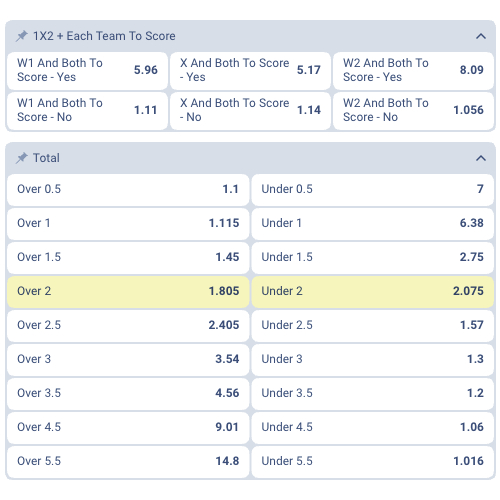
Good value often hides in the markets beyond the main result. The in-play list for football is built in layers: the result, then goals, then the small events that repeat dozens of times in a game. Most tickets on the tournament land on these few positions, which keeps them under constant correction and leaves little room for a mispriced line to survive very long. Those base lines stay open almost from kick-off to the final whistle.
From one round to the next, the same competition changes the shape of its sheet: the list is rebuilt for each new set of fixtures, according to what the current phase allows. Depth follows coverage, so a widely tracked fixture opens corner and card lines that a quieter one never shows. Alongside the day's fixtures, long-term markets cover the competition as a whole — the eventual winner, the top scorer, qualification for a given stage. Your odds are locked at the moment you bet, even as the board keeps moving with every round. The table below shows what each family settles on.
Market | What the bet covers | How it behaves in play |
|---|---|---|
1X2 live | A win for Seoul, a draw, or a win for Jeju SK from the current score | Reprices after every goal and every red card |
Total goals | Goals from both sides together, over or under the posted line | The line drops as the minutes run out |
Asian handicap | One side starts the coupon with a goal advantage | Moves as soon as the game turns one-sided |
Both teams to score | Whether Seoul and Jeju SK both find the net | Closes once the answer can no longer change |
Next goal | Which side scores next, or nobody does | Settles at the next goal or at the whistle |
Corners and cards | The count of corners or cards in a half or across the game | Runs while play continues, pauses at the break |
Correct score | The exact scoreline at the end of the match | Swings hardest in the seconds after a goal |
Everything publicly known about a fixture already sits in the price, so a position kept because it agrees with the general view repeats the consensus instead of questioning it. A market taken because it matches what is happening on the pitch lasts longer than one taken out of habit, and the lines above are read against the clock.
What moves the price right now
Three changes at once around the hour mark reset the counters: fresh legs against a settled shape, and the tempo restarts in a direction the first hour gave no clue about. Each of those turns reaches the coupon within seconds. Holding a lead also eats the clock: throw-ins take an age, goal kicks stretch out, the ball spends longer outside the pitch and the goals total suffers for it. One goal shifts the totals line, the handicap and the result price in the same refresh.
Cards make up a market of their own, match total, most-carded side or a per-team threshold, lines that play out with no reference to the score. A red card leaves a side a player short for the rest of the game, and the market treats the remaining minutes as a different match. The minutes before the interval trap defences, with concentration dipping and minds already in the dressing room, and a goal scored there rewrites the entire half-time talk. The two halves seldom carry the same rhythm, and the second is where the goal lines usually get decided.
For some sides a long throw works as an extra corner, turning every ball out of play near the box into a direct delivery toward the penalty spot. Corners and free kicks near the area are the shortest route to a goal when a side cannot build through the middle. An extra centre-back brought on to protect a slender lead shuts the match down: space disappears, play drifts away from both boxes, and chances dry up until the whistle. Fresh legs after the hour change the pressing distance, and the goal markets answer within a few minutes.
Match statistics: what they show and what they hide
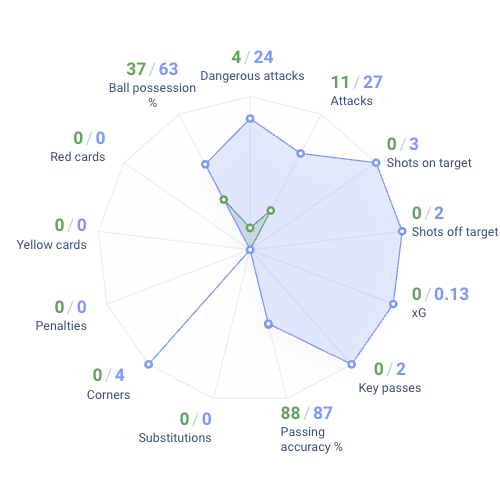
Distance covered goes up when a team is chasing the ball. A block that defends deep and shifts little often shows less running and more control. Possession, shots, shots on target, corners and dangerous attacks describe pressure, and pressure is what the goal markets price. Charts splitting goals into fifteen-minute bands inflate the last one mechanically, because it swallows stoppage time, and every team ends up looking like a late scorer. A side can hold the ball for an hour without troubling the keeper, and the counter still reads in its favour.
A reserve keeper often arrives after months without a competitive minute. Match rhythm cannot be rehearsed in training, and his first hot intervention is also his first real action in a long while. One goalkeeper in form wipes out the gap the shot count promised. A handful of outings draws nothing solid. What repeats across a long stretch carries information, while what holds over only a few meetings stays noise. Recent form of Seoul and Jeju SK explains the opening prices, then loses weight with every minute the fixture actually plays.
Placing a bet while the game is live
Tapping an odd drops the selection straight into the slip. The route is identical on a computer and on a phone.
When the same pair turns up twice in the calendar, the date and time printed beside the names are the only reliable way to tell one meeting from the other. The football list in live football holds the fixture in place from kick-off to the final whistle.
Tap the price of the market you want. In singles mode every line carries its own stake, and a missed call leaves the rest of the slip untouched. The coupon stores that figure as it stood at the tap.
Enter the stake in dirhams and check the return the coupon calculates.
Without a balance large enough to cover the stake, validation stops dead, and checking that beforehand beats discovering the block at the very moment you press. A price that moved while you were typing comes back for acceptance instead of being swapped in silently.
Follow the ticket in the list of open bets, where settlement appears once the result is official.
Where the option is offered, a running bet can be closed early for the sum shown at that moment, a judgement about the minutes still to come rather than the final score.
Prematch and live on the same fixture
Everything is open days ahead, side markets included, then the choice narrows during the meeting to whatever is still undecided, and it keeps shrinking as things settle. The prematch line opens days ahead on the football line and closes the moment the referee starts play. What each opponent still has at stake at this point of the competition is readable before the meeting, and a side defending its position plays the fixture differently from one already safe. A price taken early carries the risk of team news; one taken in play carries the risk of the next attack.
Pick the moment that suits your read of the match. A position opened before kick-off and an addition made twenty minutes in can sit in the same ticket list. Live betting keeps pace with the match, so next-goal prices move the moment a side starts pushing forward. The board stays open to the last action, and the rest of the live section works on the same clock for every other sport in play.
Money, app and help in Morocco
A small first deposit checks the whole chain end to end, and once the route is proven the following amounts go through without surprises. An account held in Morocco is funded and settled in dirhams, so no conversion stands between the deposit and the stake. A transfer to a CIH or Attijari account moves at banking pace — the request leaves at any hour, while the entry shows up on the receiving bank's working days. A withdrawal is requested from the same cashier screen, which lists the methods open for it at that moment.
Method | What it is | Currency | Suits a bettor who |
|---|---|---|---|
CIH | Moroccan bank, cards and transfers | MAD | already banks there and pays from the banking app |
Attijari | Moroccan banking network with branches nationwide | MAD | holds a card from the same group |
Al Barid | Postal banking service | MAD | uses the post office network every day |
Lbankalik | Everyday Moroccan banking service | MAD | handles the account mostly from a phone |
Cash Plus | Cash payment network with staffed counters | MAD | pays in notes at a counter, without a card |
Battery drains slower than with a tab left open for hours, since the app goes quiet between the moments you actually open it rather than running non-stop. A phone left on the fixture screen shows the same prices as a computer, and the mobile app page sets out what the download asks for. Cashing out a running bet takes one tap while the clock is still moving. A goal alert lands faster than a manual refresh, which decides whether a market is still open when you reach it.
Naming the exact moment the problem happened helps the matching record surface, as a whole day stays far too wide a window to search through. A stake that did not go through is easiest to raise from inside the account, where the ticket carries its own number. On a niche market the maximum stake stays lower than on the 1X2 of a headline fixture, and the service states the limit set for that event. The reply arrives in the same window, and the thread keeps the history.
After the final whistle
Typing the competition name into the search box leads straight to its page, quicker than opening the sport menu and scrolling down to it on every visit. Settlement runs against the official result, and the ticket moves from the open list into the history. The same section exists in French, English and Arabic; fixtures and odds stay identical from one version to the next, and only the display language differs. The competition carries on, and the next round for Seoul and Jeju SK appears on the same list within hours.
Al Barid, Lbankalik and Cash Plus top up the balance before the card begins. A game still in play keeps its board alive to the last kick, and the list rolls on to the next kick-off as soon as this one closes.