

Mexico - Chile - live odds and in-play markets
What Mexico - Chile is and where it runs
A great sporting occasion has a way of pulling everyone in, from casual viewers to those tracking every price on the board. This page follows Mexico - Chile from the first whistle to the last, and the board refreshes on its own while the ball is in play. The fixture belongs to Friendlies. National Teams, so the stage of that competition applies to this game too.
Every result is ratified by the organiser before it enters the table, and that official validation is the single reference used to settle bets. The level of a competition decides how deep the in-play list runs. The entry filter gives it away — an event open to anyone who registers has nothing like the density of one where a place is earned on previous results. A meeting of Mexico and Chile in a lower division opens fewer markets than a top-flight fixture, and the board shows only what is genuinely trading at that minute.
Head-to-head history sits beside the live board for a reason. Take a minute with the two teams' shared history before locking anything in, because patterns from earlier clashes have a way of repeating. Earlier meetings of Mexico and Chile describe habits rather than outcomes, while the standings and the rest of the calendar stay on Friendlies. National Teams for anyone checking what this result changes.
Reading the board while the game runs


Under the scoreline sit the minute, the pressure counters and the price column. Heavy money on one side nudges the price for a moment, yet any lasting move rests on something that happened in play, not on the excitement around it. A goal, a dismissal or a penalty award rewrites that column at once, so the number seen a second earlier is not the number the coupon accepts.
The scoreline governs appetite for risk — an early opener loosens the whole meeting, while a deadlock that survives into the closing stages pushes both camps to lock everything down. Reading a football match means watching where the ball spends its minutes, not only what the scoreline says. A trailing side pushing its defenders forward leaves space behind, so the next-goal market tightens in its favour while quietly getting more generous for the team countering. Such turns arrive without warning, and the market answers before the crowd does.
The freeze only covers the meeting concerned: the rest of the live page keeps quoting as usual, and nothing stops you acting elsewhere while waiting for the reopening. At the interval the list shrinks to the markets that survive a break and reopens when play restarts; a long stoppage for treatment or a video review does the same.
Live markets on this fixture
Good value often hides in the markets beyond the main result. The in-play list for football is built in layers: the result, then goals, then the small events that repeat dozens of times in a game. Even a fixture with nothing at stake, between participants nobody follows, keeps its base intact; reputation acts on the side options and never on the base set that is always there. Those base lines stay open almost from kick-off to the final whistle.
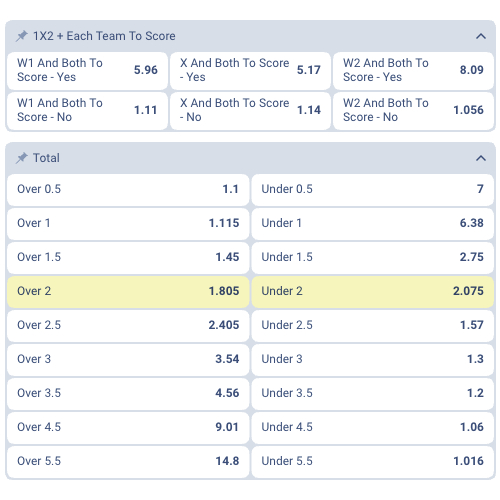
Most of the volume comes from cutting the same question into finer slices: by segment of the meeting, by participant, by combination of conditions, while the original question stays single. Depth follows coverage, so a widely tracked fixture opens corner and card lines that a quieter one never shows. Popular choices range from the outright winner and double chance to handicaps, total goals, both teams to score and the exact final score. Half-time/full-time and a spread of player and team props complete the list, and any number of them can be tied into an accumulator. The table below shows what each family settles on.
Market | What the bet covers | How it behaves in play |
|---|---|---|
1X2 live | A win for Mexico, a draw, or a win for Chile from the current score | Reprices after every goal and every red card |
Total goals | Goals from both sides together, over or under the posted line | The line drops as the minutes run out |
Asian handicap | One side starts the coupon with a goal advantage | Moves as soon as the game turns one-sided |
Both teams to score | Whether Mexico and Chile both find the net | Closes once the answer can no longer change |
Next goal | Which side scores next, or nobody does | Settles at the next goal or at the whistle |
Corners and cards | The count of corners or cards in a half or across the game | Runs while play continues, pauses at the break |
Correct score | The exact scoreline at the end of the match | Swings hardest in the seconds after a goal |
When the whole idea rests on how the meeting will start, waiting for the live phase to confirm that start beats locking the position before a ball is played. A market taken because it matches what is happening on the pitch lasts longer than one taken out of habit, and the lines above are read against the clock.
What moves the price right now
In heavy heat the referee grants a cooling break and the game drops a gear after the hour: runs get shorter, transitions come further apart, and a fixture that promised plenty ends up a quiet one. Each of those turns reaches the coupon within seconds. The 90th minute settles nothing, because added time regularly flips totals and both-teams-to-score, and a slip is only judged at the final whistle. One goal shifts the totals line, the handicap and the result price in the same refresh.
The referee's temperament matters as much as the teams': some let duels run, others reach for the notebook at first contact, and the card count follows whoever is in the middle. A red card leaves a side a player short for the rest of the game, and the market treats the remaining minutes as a different match. The interval breaks rhythms; a side that had the match by the collar can come back flat, while the other one has had time to breathe and reorganise itself. The two halves seldom carry the same rhythm, and the second is where the goal lines usually get decided.
A short corner pulls one defender out of the block and reopens the crossing angle the defence had just closed down. Corners and free kicks near the area are the shortest route to a goal when a side cannot build through the middle. Shape can change without anyone leaving the pitch: a full-back tucks inside, the back line becomes a three, and the game takes on a completely different look. Fresh legs after the hour change the pressing distance, and the goal markets answer within a few minutes.
Match statistics: what they show and what they hide
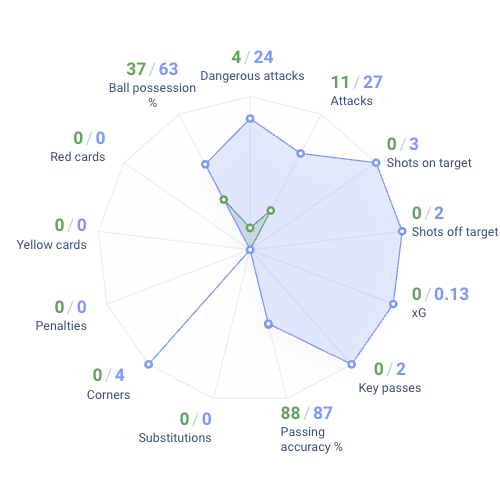
Possession on its own says nothing: passing the ball across the front of a low block without ever shooting fills time, it does not bring a goal any closer. Possession, shots, shots on target, corners and dangerous attacks describe pressure, and pressure is what the goal markets price. A goalkeeper leading the saves chart usually plays behind the leakiest defence, since that total counts shots faced long before it measures ability. A side can hold the ball for an hour without troubling the keeper, and the counter still reads in its favour.
A goalkeeper who takes a knock almost always stays on, since the position rarely gets substituted mid-game; the clue sits in his long kicks, which shorten well before any change is considered. One goalkeeper in form wipes out the gap the shot count promised. Staying unbeaten for a long time describes what has already happened and holds no promise for the meeting ahead; every such run ends somewhere, usually without any warning sign. Recent form of Mexico and Chile explains the opening prices, then loses weight with every minute the fixture actually plays.
Placing a bet while the game is live
The possible return appears as soon as the stake is typed. The route is identical on a computer and on a phone.
The counter shown next to each competition tells how many meetings are open at that moment, answering before any click whether the page is worth opening. The football list in live football holds the fixture in place from kick-off to the final whistle.
Tap the price of the market you want. An accumulator's total price is the product of every line's odds, and each added selection multiplies the figure again. The coupon stores that figure as it stood at the tap.
Enter the stake in dirhams and check the return the coupon calculates.
Two positions taken from the same fixture do not always combine, and the slip flags the clash before validation — sorting it out there beats running into a refusal. A price that moved while you were typing comes back for acceptance instead of being swapped in silently.
Follow the ticket in the list of open bets, where settlement appears once the result is official.
Where the option is offered, a running bet can be closed early for the sum shown at that moment, a judgement about the minutes still to come rather than the final score.
Prematch and live on the same fixture
The two registers work together, because when a meeting turns sour, a live position taken the other way can shield the stake placed before the start. The prematch line opens days ahead on the football line and closes the moment the referee starts play. Waiting for confirmed news about the participants changes what a fixture is worth, since one late absence shifts the balance between them and gives real cause to rethink. A price taken early carries the risk of team news; one taken in play carries the risk of the next attack.
An outsider's price sits at its highest before the start and shrinks the moment he moves in front. A position opened before kick-off and an addition made twenty minutes in can sit in the same ticket list. The live screen lines up shots on target, possession and dangerous attacks beside the odds, and the real pressure reads in those columns rather than on the scoreboard alone. The board stays open to the last action, and the rest of the live section works on the same clock for every other sport in play.
Money, app and help in Morocco
A glance at the balance line after confirming shows the money has landed, and the betslip is then built on a figure that is certain. An account held in Morocco is funded and settled in dirhams, so no conversion stands between the deposit and the stake. Every withdrawal request carries a status in the payment history, and following it there spares a support message about an operation that is simply running its course. A withdrawal is requested from the same cashier screen, which lists the methods open for it at that moment.
Method | What it is | Currency | Suits a bettor who |
|---|---|---|---|
CIH | Moroccan bank, cards and transfers | MAD | already banks there and pays from the banking app |
Attijari | Moroccan banking network with branches nationwide | MAD | holds a card from the same group |
Al Barid | Postal banking service | MAD | uses the post office network every day |
Lbankalik | Everyday Moroccan banking service | MAD | handles the account mostly from a phone |
Cash Plus | Cash payment network with staffed counters | MAD | pays in notes at a counter, without a card |
Sections stay loaded on the device, so moving from one competition to another happens without the blank pause that a full page reload brings. A phone left on the fixture screen shows the same prices as a computer, and the mobile app page sets out what the download asks for. Filters split the weekend card by sport and by kickoff time. A goal alert lands faster than a manual refresh, which decides whether a market is still open when you reach it.
Before opening a ticket, a look through the help section settles the most common cases on the spot, with no queue and no exchange of messages. A stake that did not go through is easiest to raise from inside the account, where the ticket carries its own number. For a payout to CIH or Attijari, support spells out which details have to match the account before the request goes through. The reply arrives in the same window, and the thread keeps the history.
After the final whistle
While a round is being played, the page lines up the running scores next to the fixtures still to come, and the whole day reads in a single glance. Settlement runs against the official result, and the ticket moves from the open list into the history. Starting with the one meeting that genuinely appeals is the simplest way in, and the rest of the competition opens up afterwards, step by step. The competition carries on, and the next round for Mexico and Chile appears on the same list within hours.
Don't watch from the sidelines. A game still in play keeps its board alive to the last kick, and the list rolls on to the next kick-off as soon as this one closes.