

Chernomorets Burgas - Botev Plovdiv - live odds and in-play markets
What Chernomorets Burgas - Botev Plovdiv is and where it runs
When a highly anticipated contest looms on the calendar, supporters and bettors alike start counting down together. This page follows Chernomorets Burgas - Botev Plovdiv from the first whistle to the last, and the board refreshes on its own while the ball is in play. The fixture belongs to Bulgarian Cup, so the stage of that competition applies to this game too.
A championship sits inside a pyramid, and its verdict opens the floor above, whether that means a promotion or a ticket into a wider competition. The level of a competition decides how deep the in-play list runs. Do the points handed out count anywhere else? An event feeding a wider ranking obliges entrants to turn up, while one feeding nothing is played for its own sake. A meeting of Chernomorets Burgas and Botev Plovdiv in a lower division opens fewer markets than a top-flight fixture, and the board shows only what is genuinely trading at that minute.
Head-to-head history sits beside the live board for a reason. Before you back a side, it pays to glance at how these two have fared against each other in the past, because those earlier meetings often hint at what to expect. Earlier meetings of Chernomorets Burgas and Botev Plovdiv describe habits rather than outcomes, while the standings and the rest of the calendar stay on Bulgarian Cup for anyone checking what this result changes.
Reading the board while the game runs


Under the scoreline sit the minute, the pressure counters and the price column. A score against the run of play is absorbed cautiously: the line moves less than after one that confirms what the meeting was already showing. A goal, a dismissal or a penalty award rewrites that column at once, so the number seen a second earlier is not the number the coupon accepts.
The stream always runs a few seconds behind the venue, so when a price lurches with nothing visible on screen, the cause already exists — it simply has not been shown yet. Reading a football match means watching where the ball spends its minutes, not only what the scoreline says. A goal reprices everything at once, because the market does not just adjust the result, it rethinks the rest of the match, and the earlier it lands the sharper the move. Such turns arrive without warning, and the market answers before the crowd does.
Rushing at the first price after a reopening rarely helps: it keeps moving while the situation finishes clarifying and the book absorbs what just happened. At the interval the list shrinks to the markets that survive a break and reopens when play restarts; a long stoppage for treatment or a video review does the same.
Live markets on this fixture
Double chance covers two of the three outcomes and charges for that cover in the price. The in-play list for football is built in layers: the result, then goals, then the small events that repeat dozens of times in a game. The vocabulary of the base carries from one discipline to the next, and a grid learned on one sport rereads unchanged on all the others. Those base lines stay open almost from kick-off to the final whistle.
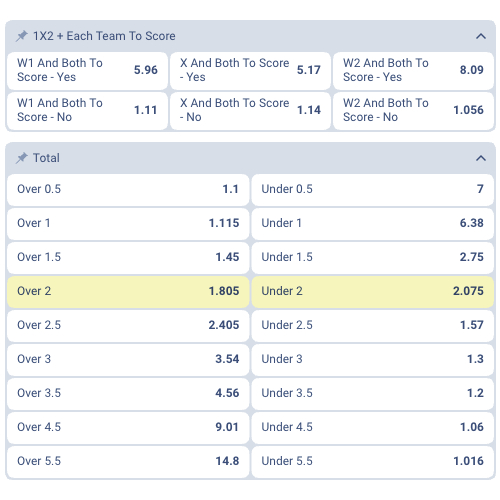
Minute-level markets exist only where a reliable feed comes up from the venue; without that collection the sheet stays on its basic lines, whatever the fixture's prestige. Depth follows coverage, so a widely tracked fixture opens corner and card lines that a quieter one never shows. Sharper lines cover the exact number of goals, the parity of the total, or a win without conceding. They pay better than the main markets, in exchange for a precision that only the full script of the match can validate. The table below shows what each family settles on.
Market | What the bet covers | How it behaves in play |
|---|---|---|
1X2 live | A win for Chernomorets Burgas, a draw, or a win for Botev Plovdiv from the current score | Reprices after every goal and every red card |
Total goals | Goals from both sides together, over or under the posted line | The line drops as the minutes run out |
Asian handicap | One side starts the coupon with a goal advantage | Moves as soon as the game turns one-sided |
Both teams to score | Whether Chernomorets Burgas and Botev Plovdiv both find the net | Closes once the answer can no longer change |
Next goal | Which side scores next, or nobody does | Settles at the next goal or at the whistle |
Corners and cards | The count of corners or cards in a half or across the game | Runs while play continues, pauses at the break |
Correct score | The exact scoreline at the end of the match | Swings hardest in the seconds after a goal |
Running the same line across every fixture of the round shows where your own reading strays furthest from the posted price, and that fixture is the one worth taking. A market taken because it matches what is happening on the pitch lasts longer than one taken out of habit, and the lines above are read against the clock.
What moves the price right now
The scoreboard reads the same after a saved penalty, yet everything else shifts: the keeper who pushes it away lifts his team, the player who missed starts passing sideways, and the next goal often changes ends. Each of those turns reaches the coupon within seconds. An equaliser is usually followed by a short spell of mutual caution, the match resets tactically, and the minutes right after show which side absorbed the blow better. One goal shifts the totals line, the handicap and the result price in the same refresh.
After a red the coach nearly always sacrifices a forward to rebuild the block, so the reduced side loses more going forward than it does at the back. A red card leaves a side a player short for the rest of the game, and the market treats the remaining minutes as a different match. Across a full season, the second half produces more goals than the first in most leagues, and the half-by-half lines are priced with that gap in mind. The two halves seldom carry the same rhythm, and the second is where the goal lines usually get decided.
On the last corner of a match slipping away, the goalkeeper walks up into the opposite box, and the danger runs both ways because the net behind him stands empty. Corners and free kicks near the area are the shortest route to a goal when a side cannot build through the middle. Late changes are also a way of eating the clock: the player walks off slowly, the referee adds a little back, yet the ball spends more time standing still. Fresh legs after the hour change the pressing distance, and the goal markets answer within a few minutes.
Match statistics: what they show and what they hide
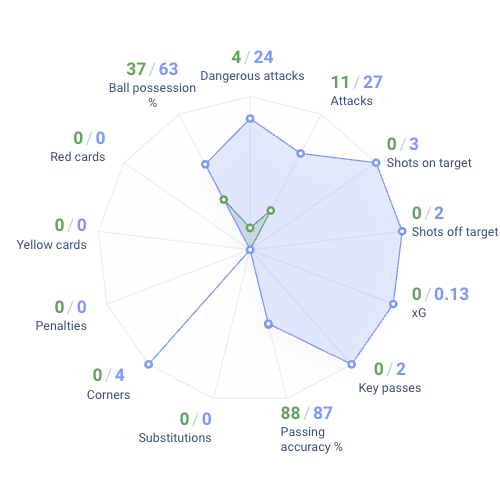
Head-to-head records age quickly: three seasons back, the table is describing two departed coaches, a rebuilt centre-back pairing and a squad that has since turned over. Possession, shots, shots on target, corners and dangerous attacks describe pressure, and pressure is what the goal markets price. Two data providers can hand the same match different expected-goals figures, since every model weighs chances its own way, and the number depends on who computed it. A side can hold the ball for an hour without troubling the keeper, and the counter still reads in its favour.
Switching between a back four and a back three mid-match redistributes the flanks; for several minutes nobody is quite sure who picks up the opposite winger, and that window is where the mistakes happen. One goalkeeper in form wipes out the gap the shot count promised. A run is worth only as much as the opponents inside it; stacking wins against the bottom of the table prepares nobody for the first genuine test of the competition. Recent form of Chernomorets Burgas and Botev Plovdiv explains the opening prices, then loses weight with every minute the fixture actually plays.
Placing a bet while the game is live
There's nothing complicated about backing the team you fancy. The route is identical on a computer and on a phone.
A finished meeting drops out of the betting list altogether, and its final score is looked up in the results section, which keeps the outcome of every completed matchday. The football list in live football holds the fixture in place from kick-off to the final whistle.
Tap the price of the market you want. Tabs at the top of the slip move the same selections from one bet type to another, sparing you the job of rebuilding the list line by line. The coupon stores that figure as it stood at the tap.
Enter the stake in dirhams and check the return the coupon calculates.
Each market carries a floor and a ceiling for the stake; an amount outside those bounds blocks validation, and adjusting it inside the slip keeps the selection intact. A price that moved while you were typing comes back for acceptance instead of being swapped in silently.
Follow the ticket in the list of open bets, where settlement appears once the result is official.
Where the option is offered, a running bet can be closed early for the sum shown at that moment, a judgement about the minutes still to come rather than the final score.
Prematch and live on the same fixture
One stake placed before the start is a single amount weighed once, in dirhams; live, decisions arrive one after another and the total committed gets harder to track. The prematch line opens days ahead on the football line and closes the moment the referee starts play. Taking a position as soon as the market opens means acting ahead of the crowd, while the price still reflects the opening work rather than the weight of everything staked since. A price taken early carries the risk of team news; one taken in play carries the risk of the next attack.
Timing is a big part of the strategy. A position opened before kick-off and an addition made twenty minutes in can sit in the same ticket list. live betting responds to every key moment on the pitch. The board stays open to the last action, and the rest of the live section works on the same clock for every other sport in play.
Money, app and help in Morocco
From a phone the routine stays identical — the same form, the same fields to fill, the same confirmation step as on a desktop screen. An account held in Morocco is funded and settled in dirhams, so no conversion stands between the deposit and the stake. Nothing ties a payout to the tournament calendar; the request can be filed while the fixtures are still running or once the last of them is done. A withdrawal is requested from the same cashier screen, which lists the methods open for it at that moment.
Method | What it is | Currency | Suits a bettor who |
|---|---|---|---|
CIH | Moroccan bank, cards and transfers | MAD | already banks there and pays from the banking app |
Attijari | Moroccan banking network with branches nationwide | MAD | holds a card from the same group |
Al Barid | Postal banking service | MAD | uses the post office network every day |
Lbankalik | Everyday Moroccan banking service | MAD | handles the account mostly from a phone |
Cash Plus | Cash payment network with staffed counters | MAD | pays in notes at a counter, without a card |
The Android build is downloaded from the official site and the iOS build from the App Store, each with its own guided install. A phone left on the fixture screen shows the same prices as a computer, and the mobile app page sets out what the download asks for. Topping up runs through Al Barid or Lbankalik without leaving the app. A goal alert lands faster than a manual refresh, which decides whether a market is still open when you reach it.
Copying the error message word for word beats paraphrasing it, since each wording maps to a specific cause the agent recognises at once. A stake that did not go through is easiest to raise from inside the account, where the ticket carries its own number. In live play a slip can be turned down when the price moves at the instant you confirm, and support finds that attempt in the history to explain why. The reply arrives in the same window, and the thread keeps the history.
After the final whistle
On meeting days the competition moves into the live section as soon as play begins, and that is where to find it once the pre-match line has closed. Settlement runs against the official result, and the ticket moves from the open list into the history. Funding an account runs through the usual Moroccan channels — CIH, Attijari, Al Barid, Lbankalik, Cash Plus — and takes less time than reading through the calendar. The competition carries on, and the next round for Chernomorets Burgas and Botev Plovdiv appears on the same list within hours.
The countdown is nearly over. A game still in play keeps its board alive to the last kick, and the list rolls on to the next kick-off as soon as this one closes.