

Stoke City - Millwall - live odds and in-play markets
What Stoke City - Millwall is and where it runs
When two strong opponents are about to meet, enthusiasm spreads quickly and the countdown itself becomes part of the fun. This page follows Stoke City - Millwall from the first whistle to the last, and the board refreshes on its own while the ball is in play. The fixture belongs to England. Championship, so the stage of that competition applies to this game too.
Results here outlive the day they were produced; each one enters a standing table, weighs on everything that follows, and cannot be shrugged off the way a friendly can. The level of a competition decides how deep the in-play list runs. The list of winners over a decade settles the question: two names coming back over and over point to a narrow field, ten different champions point to genuine competition. A meeting of Stoke City and Millwall in a lower division opens fewer markets than a top-flight fixture, and the board shows only what is genuinely trading at that minute.
Head-to-head history sits beside the live board for a reason. A meeting on neutral ground reads differently from one at a familiar venue, even between the same two opponents. Earlier meetings of Stoke City and Millwall describe habits rather than outcomes, while the standings and the rest of the calendar stay on England. Championship for anyone checking what this result changes.
Reading the board while the game runs
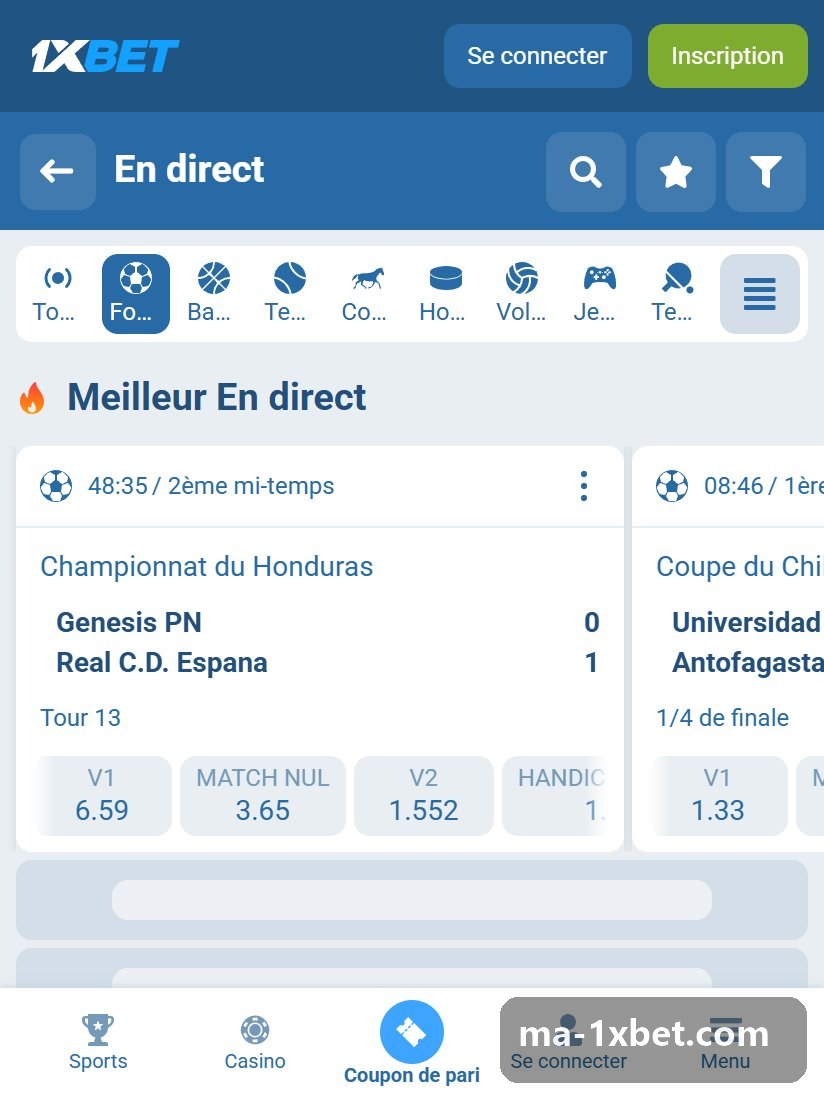

Under the scoreline sit the minute, the pressure counters and the price column. Movement comes in steps rather than a smooth curve: the line sits still, jumps, then freezes again, because information reaches the book in bursts. A goal, a dismissal or a penalty award rewrites that column at once, so the number seen a second earlier is not the number the coupon accepts.
Long interruptions stretch the meeting beyond its expected length, so a position taken late can have more play ahead of it than the schedule suggested. Reading a football match means watching where the ball spends its minutes, not only what the scoreline says. A trailing side pushing its defenders forward leaves space behind, so the next-goal market tightens in its favour while quietly getting more generous for the team countering. Such turns arrive without warning, and the market answers before the crowd does.
Each sport has its own freeze points, such as a dangerous attack, a set point or the siren ending a period, and the suspensions map onto those moments rather than falling at random. At the interval the list shrinks to the markets that survive a break and reopens when play restarts; a long stoppage for treatment or a video review does the same.
Live markets on this fixture
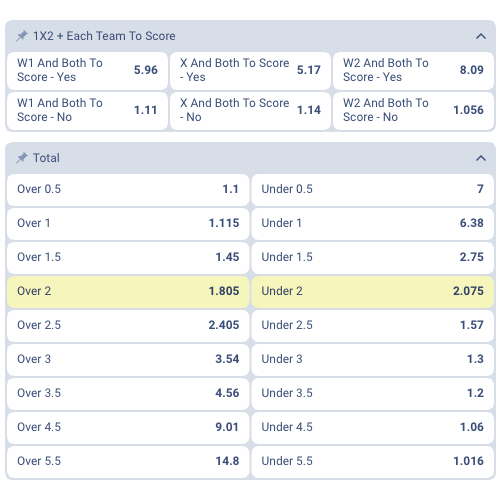
Special bets settle on a single detail, whatever the final scoreline says. The in-play list for football is built in layers: the result, then goals, then the small events that repeat dozens of times in a game. A full day of competition can be covered from this base alone, without opening the detailed sheet, which makes it the quickest format to scan when fixtures come one after another. Those base lines stay open almost from kick-off to the final whistle.
Depth makes it possible to stay on one fixture: working several angles of a meeting you actually know beats scattering stakes across games skimmed in passing. Depth follows coverage, so a widely tracked fixture opens corner and card lines that a quieter one never shows. The meeting also splits into segments: a half, a period, a set or a round depending on the sport, with lines on the result or total of a given segment. These reward knowing a side's tempo, slow starters and strong finishers alike. The table below shows what each family settles on.
Market | What the bet covers | How it behaves in play |
|---|---|---|
1X2 live | A win for Stoke City, a draw, or a win for Millwall from the current score | Reprices after every goal and every red card |
Total goals | Goals from both sides together, over or under the posted line | The line drops as the minutes run out |
Asian handicap | One side starts the coupon with a goal advantage | Moves as soon as the game turns one-sided |
Both teams to score | Whether Stoke City and Millwall both find the net | Closes once the answer can no longer change |
Next goal | Which side scores next, or nobody does | Settles at the next goal or at the whistle |
Corners and cards | The count of corners or cards in a half or across the game | Runs while play continues, pauses at the break |
Correct score | The exact scoreline at the end of the match | Swings hardest in the seconds after a goal |
When the whole idea rests on how the meeting will start, waiting for the live phase to confirm that start beats locking the position before play begins. A market taken because it matches what is happening on the pitch lasts longer than one taken out of habit, and the lines above are read against the clock.
What moves the price right now
Heavy rain and a soaked pitch slow everything down: passes get stuck, chances turn scrappy, play piles up near the corner flags — a scenario that quietly favours the corners and the under. Each of those turns reaches the coupon within seconds. Every goalless minute works for the under, and the longer the clock runs on a blank scoreline, the higher the price on the over climbs. One goal shifts the totals line, the handicap and the result price in the same refresh.
The referee's temperament matters as much as the teams': some let duels run, others reach for the notebook at first contact, and the card count follows whoever is in the middle. A red card leaves a side a player short for the rest of the game, and the market treats the remaining minutes as a different match. Added time carries more weight after the break, with stoppages piling up and changes running one after another, so a match is still alive when it already looks over. The two halves seldom carry the same rhythm, and the second is where the goal lines usually get decided.
A corner commits both teams at once; the side sending its tall players forward leaves its own half thinned out, and one caught clearance launches runners into open space. Corners and free kicks near the area are the shortest route to a goal when a side cannot build through the middle. Two forwards sent on together when a goal is badly needed leave the midfield exposed; the threat grows at one end, and it grows just as fast at the other. Fresh legs after the hour change the pressing distance, and the goal markets answer within a few minutes.
Match statistics: what they show and what they hide
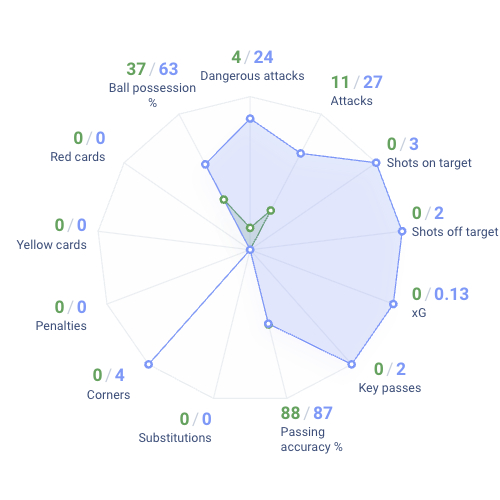
Distance covered goes up when a team is chasing the ball. A block that defends deep and shifts little often shows less running and more control. Possession, shots, shots on target, corners and dangerous attacks describe pressure, and pressure is what the goal markets price. A single league table adds two different teams together, the home version and the away one, and the gap between them can be wide enough that the average describes neither. A side can hold the ball for an hour without troubling the keeper, and the counter still reads in its favour.
A midfield change gets diluted among several players who share the running. In goal nobody shares anything: the replacement inherits the entire job from the first whistle to the last. One goalkeeper in form wipes out the gap the shot count promised. The price of a long run is physical; built on a congested calendar it delivers honest results, yet it leaves the tank low just as the next stretch arrives. Recent form of Stoke City and Millwall explains the opening prices, then loses weight with every minute the fixture actually plays.
Placing a bet while the game is live
Al Barid, Lbankalik and Cash Plus also credit the account. The route is identical on a computer and on a phone.
On the competition page, fixtures come grouped by round, so a whole round can be scanned in one look before deciding where to stop. The football list in live football holds the fixture in place from kick-off to the final whistle.
Tap the price of the market you want. The odds format switches in the account settings, and the slip then shows the same prices written another way, while the value itself never moves. The coupon stores that figure as it stood at the tap.
Enter the stake in dirhams and check the return the coupon calculates.
On a handicap line the sign matters as much as the number: minus one and a half and plus one and a half describe opposite bets, and the two rows sit one right above the other. A price that moved while you were typing comes back for acceptance instead of being swapped in silently.
Follow the ticket in the list of open bets, where settlement appears once the result is official.
Where the option is offered, a running bet can be closed early for the sum shown at that moment, a judgement about the minutes still to come rather than the final score.
Prematch and live on the same fixture
The two menus never fully overlap, since long-term bets on the competition's outcome exist only beforehand, while next-point markets are born once play is under way. The prematch line opens days ahead on the football line and closes the moment the referee starts play. Amounts are easier to weigh in advance, in dirhams and across a full day of the competition, instead of fixture by fixture whenever the urge shows up. A price taken early carries the risk of team news; one taken in play carries the risk of the next attack.
In play the total is re-priced on the time that remains, not on the whole game. A position opened before kick-off and an addition made twenty minutes in can sit in the same ticket list. In-play football makes every attack matter, as odds rise and fall with each shot and counterattack. The board stays open to the last action, and the rest of the live section works on the same clock for every other sport in play.
Money, app and help in Morocco
A deposit form closed before confirmation leaves the balance untouched, and it can be filled in again from the start whenever it suits. An account held in Morocco is funded and settled in dirhams, so no conversion stands between the deposit and the stake. Looking over the withdrawal options before the competition begins, rather than after its last round, leaves time to fill in any missing profile detail. A withdrawal is requested from the same cashier screen, which lists the methods open for it at that moment.
Method | What it is | Currency | Suits a bettor who |
|---|---|---|---|
CIH | Moroccan bank, cards and transfers | MAD | already banks there and pays from the banking app |
Attijari | Moroccan banking network with branches nationwide | MAD | holds a card from the same group |
Al Barid | Postal banking service | MAD | uses the post office network every day |
Lbankalik | Everyday Moroccan banking service | MAD | handles the account mostly from a phone |
Cash Plus | Cash payment network with staffed counters | MAD | pays in notes at a counter, without a card |
One account covers both the site and the app, with balance, history and pending slips identical on either side. A phone left on the fixture screen shows the same prices as a computer, and the mobile app page sets out what the download asks for. In the app, the live section lists every event currently running. A goal alert lands faster than a manual refresh, which decides whether a market is still open when you reach it.
Writing in the language of the version you are browsing avoids a detour through translation and puts you in front of someone who answers straight away. A stake that did not go through is easiest to raise from inside the account, where the ticket carries its own number. In live play a slip can be turned down when the price moves at the instant you confirm, and support finds that attempt in the history to explain why. The reply arrives in the same window, and the thread keeps the history.
After the final whistle
The outright winner market stays open until the competition is decided, and the way its prices drift tells its own story of the contest, contender by contender. Settlement runs against the official result, and the ticket moves from the open list into the history. Prices keep moving, so any written description trails behind them, while the section itself shows where things stand at this moment. The competition carries on, and the next round for Stoke City and Millwall appears on the same list within hours.
Excitement builds as the start draws near. A game still in play keeps its board alive to the last kick, and the list rolls on to the next kick-off as soon as this one closes.